
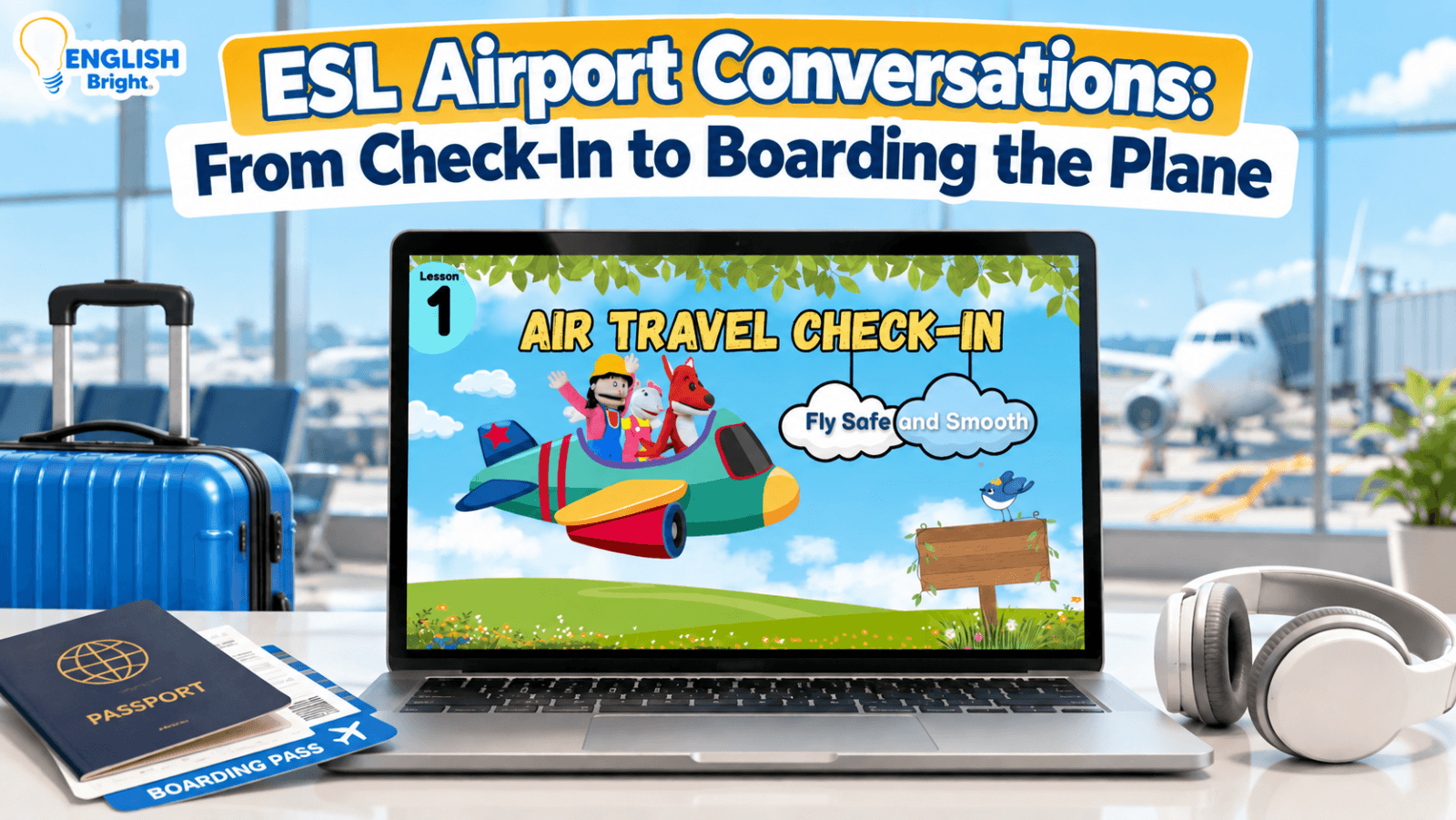
Air travel is an exciting and practical topic for English learners. Whether students are preparing for their first flight, planning an international vacation, or simply learning how airports work, understanding airport conversations can help them communicate more confidently in real-life situations.
For ESL teachers, airport conversations offer an excellent opportunity to combine vocabulary, listening, pronunciation, and speaking practice. Students can learn how to check in for a flight, answer questions at airport security, understand boarding announcements, and communicate with airport staff.
Using ESL Audio activities alongside interactive lessons makes these situations easier to understand. Students can listen to realistic conversations, recognize important travel expressions, and practice responding naturally.
With English Bright ESL, teachers can introduce air travel through engaging activities that help students build practical communication skills from check-in to boarding the plane.
Why Teach Airport Conversations in ESL Classes?
Airport English is an important part of everyday communication, especially for students who want to travel internationally.
Unlike traditional vocabulary lessons, airport conversations introduce learners to situations where they need to listen carefully, understand instructions, and respond appropriately.
Teaching English through travel topics helps students develop several essential skills:
- Recognizing common airport vocabulary and expressions
- Listening to instructions from airport staff
- Asking and answering questions during check-in
- Understanding airport security procedures
- Following boarding announcements
- Practicing polite and confident communication
These skills make ESL travel lessons for beginners both practical and meaningful.
For younger learners, teachers can simplify airport situations through pictures and games. For teenagers and adults, lessons can include realistic dialogues and more detailed travel scenarios.

Explore Air Travel With English Bright ESL Interactive Lessons
One effective way to introduce airport English is through the English Bright ESL Air Travel Lesson, which focuses on practical conversations and essential vocabulary students may encounter when flying.
This lesson explores two important stages of the airport experience: Checking In and Airport Security Checks.
Students learn how travelers communicate with airport employees, prepare their documents, follow security instructions, and understand what happens before boarding a flight.
The lesson also introduces vocabulary related to the departure and boarding process, including:
- Departure lounge: The waiting area where passengers stay before boarding their flights.
- Boarding gate: The designated location where passengers enter the aircraft.
- Boarding announcement: An announcement informing passengers when and where to board.
- Priority boarding: Early boarding offered to eligible passengers.
- Seating zone: A designated group or section used to organize passengers during boarding.
These expressions help students understand the airport environment while building their confidence in listening and speaking.
Teachers can use the lesson as part of their interactive ESL travel lessons, combining vocabulary introduction, guided conversations, and situational speaking practice.
Practice Airport Check-In Conversations
Checking in is often one of the first situations travelers experience at an airport.
Students should learn how to greet airport staff, present travel documents, check luggage, and ask questions about their flights.
Sample ESL Airport Check-In Dialogue
Airport Staff: Good morning! Where are you flying today?
Passenger: I’m flying to Singapore.
Airport Staff: May I see your passport and booking confirmation, please?
Passenger: Certainly. Here they are.
Airport Staff: Are you checking in any luggage?
Passenger: Yes, I have one suitcase.
Airport Staff: Thank you. Here is your boarding pass. Your flight departs at 10:30 AM.
Passenger: Thank you very much!
Airport Staff: You’re welcome. Have a pleasant flight!
This dialogue introduces useful expressions such as May I see your passport?, Are you checking in any luggage?, and Here is your boarding pass.
Teachers can turn the conversation into a role-play activity by assigning students the roles of passenger and airport employee.

Learn Airport Security Check Conversations
Airport security is another important part of air travel.
Students need to understand common instructions and respond politely when security officers ask questions.
The English Bright ESL Air Travel Lesson introduces airport security situations, helping learners become familiar with the language used during screening.
Sample Airport Security Dialogue
Security Officer: Please place your bag on the conveyor belt.
Passenger: Do I need to remove my laptop?
Security Officer: Yes, please place it in a separate tray.
Passenger: Should I take off my jacket, too?
Security Officer: Yes, please.
Passenger: All right. Thank you!
Security Officer: You’re welcome. Please walk through the scanner.
Teachers can use this conversation to practice listening comprehension and following instructions.
Students can also learn useful action verbs such as remove, place, open, walk, and wait.
For younger learners, teachers can demonstrate these actions through pictures, gestures, and interactive matching games.
Build Airport Vocabulary Through ESL Audio Activities
Listening is an essential skill when traveling by air. Airports can be noisy, and passengers often need to understand announcements quickly.
Using ESL Audio activities allows students to become familiar with spoken English in realistic airport situations.
Teachers can introduce short listening exercises featuring check-in conversations, security instructions, and boarding announcements.
Sample Boarding Announcement
“Attention, passengers traveling on Flight 205 to Tokyo. Boarding will begin shortly at Gate 12. Passengers with priority boarding may proceed to the gate first. All other passengers should wait until their seating zone is announced.”
After listening, students can answer comprehension questions:
- What is the flight number?
- Where is the plane going?
- Which gate should passengers use?
- Who can board first?
- What should other passengers wait for?
Teachers can read the announcement aloud, record their own version, or use suitable ESL audio recordings.
This activity strengthens listening comprehension while reinforcing vocabulary from the English Bright ESL Air Travel Lesson.
Practice Conversations at the Boarding Gate
Once travelers complete security checks, they usually proceed to the departure lounge and wait for their boarding announcement.
This creates another opportunity for students to practice real-life airport conversations.
Sample Boarding Gate Dialogue
Passenger: Excuse me, is this the boarding gate for Flight 205?
Gate Agent: Yes, it is. May I see your boarding pass?
Passenger: Here you go.
Gate Agent: Thank you. You’re in Seating Zone 3.
Passenger: Has boarding started yet?
Gate Agent: Priority boarding has started. Please wait until Zone 3 is called.
Passenger: Okay, thank you for your help!
This conversation teaches students how to ask for information, confirm details, and follow boarding instructions.
Teachers can extend the activity by changing the flight number, destination, gate, or seating zone.
These simple changes encourage learners to produce their own sentences rather than memorize an entire dialogue.

Make ESL Travel Lessons More Interactive
Airport English becomes more memorable when students actively participate in the learning process.
Teachers can use several ESL travel activities for students to reinforce vocabulary and communication skills.
Airport Vocabulary Matching
Show pictures of a passport, boarding pass, suitcase, departure lounge, and boarding gate. Ask students to match each picture with the correct vocabulary word.
Airport Role-Play Challenge
Create different travel situations. One student acts as the airport employee while another acts as the passenger.
Students practice asking questions, giving information, and responding politely.
Listen and Choose
Read or play an airport announcement. Students identify the correct flight number, boarding gate, or seating zone from multiple choices.
Plan Your Airport Journey
Ask students to arrange the airport experience in the correct order:
- Check in for the flight.
- Drop off checked luggage.
- Go through airport security.
- Find the departure lounge and boarding gate.
- Listen for the boarding announcement.
- Board the plane.
These activities work well for ESL travel activities for online classes, particularly when teachers use interactive slides and visual prompts.
Adapt Air Travel Lessons for Different English Levels
Airport conversations can be adjusted to suit different ages and language abilities.
For ESL travel lessons for kids, focus on simple vocabulary such as plane, airport, passport, suitcase, and ticket. Use pictures, repetition, and short questions to build familiarity.
Beginners can practice sentence patterns such as:
- “Where is my gate?”
- “Here is my passport.”
- “I have one suitcase.”
- “When does boarding start?”
For more advanced learners, including teenagers and adults, introduce complex situations such as missed flights, connecting flights, delayed departures, and lost luggage.
Teachers can also ask students to explain airport procedures or compare air travel experiences in different countries.
This flexibility makes air travel one of the most useful ESL travel topics for English learners.

Bring Real-Life Airport Conversations Into Your ESL Classroom
Teaching airport English is about more than memorizing travel vocabulary. It helps students develop the listening and speaking skills they need to communicate confidently in unfamiliar situations.
By combining ESL Audio, practical dialogues, vocabulary exercises, and interactive role-play activities, teachers can create meaningful lessons that prepare learners for real-world communication.
The English Bright ESL Air Travel Lesson provides a useful starting point for exploring checking in, airport security checks, and important boarding vocabulary. Teachers can build on these topics with listening exercises, conversation practice, and interactive activities that encourage students to use English naturally.
Whether you’re teaching beginners, young learners, teenagers, or adults, airport conversations offer practical language skills students can carry beyond the classroom.
Make travel English more engaging with English Bright ESL. Explore ready-to-teach interactive lessons designed to make vocabulary, listening, and speaking practice easier for both teachers and students.
Less prep. More teaching.



Leave a Reply