
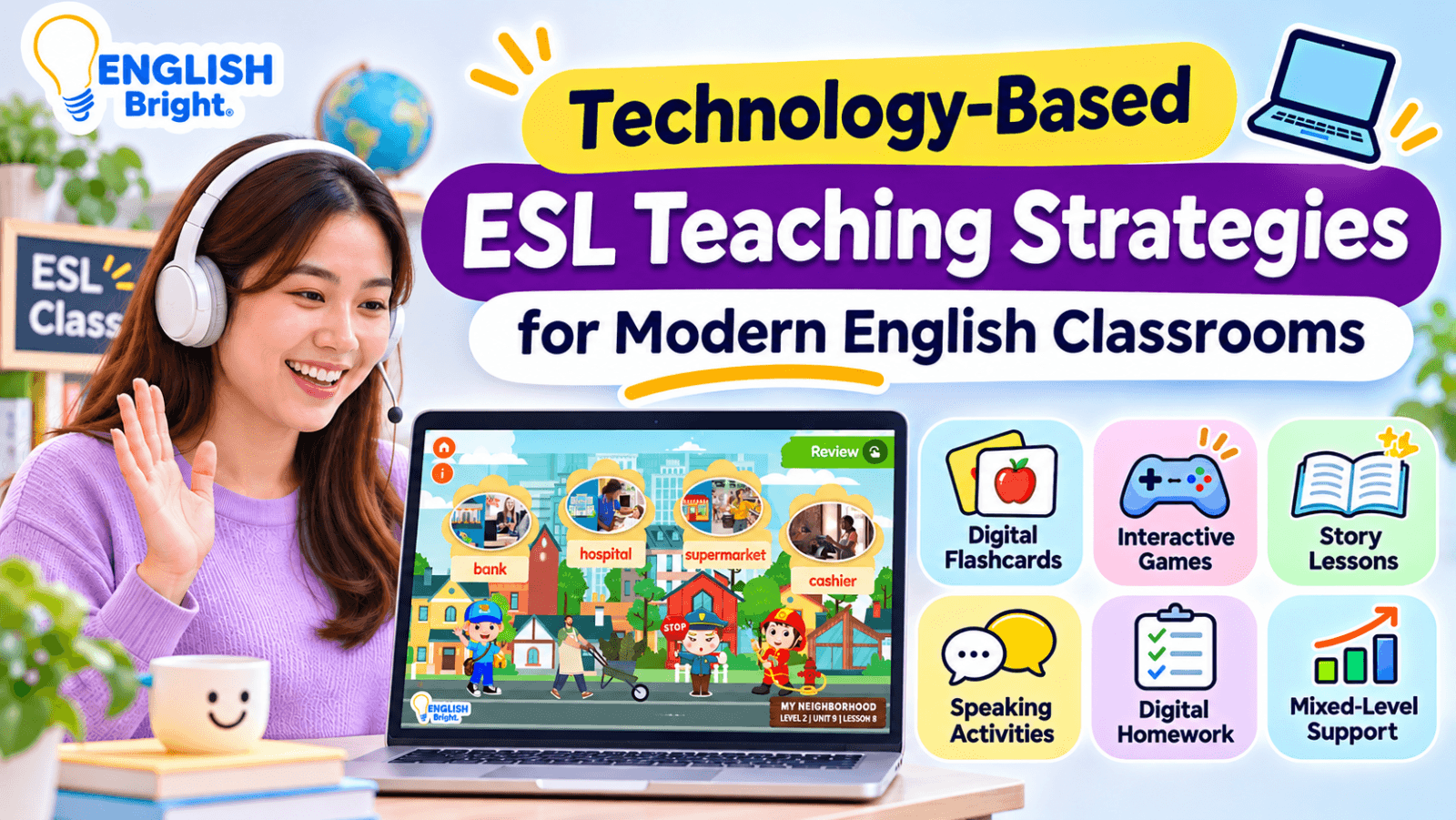
Technology has transformed how teachers deliver English lessons, making classrooms more interactive, flexible, and engaging. From digital flashcards and educational games to interactive presentations and online homework, teachers now have more opportunities to help students develop their English skills through meaningful activities.
However, using technology effectively requires more than simply displaying digital materials. Teachers need structured lessons, clear learning objectives, and activities that encourage students to participate actively.
That is why choosing the right ESL strategies for teachers is essential. Whether teaching beginners, young learners, elementary students, or mixed-level classes, technology-based strategies can help teachers create engaging lessons while supporting vocabulary development, pronunciation, reading, grammar, and speaking confidence.
In this guide, we will explore practical technology-based ESL teaching strategies and how English Bright ESL can help teachers deliver structured, interactive English lessons with less preparation.
Use Interactive ESL Lessons Instead of Traditional Presentations
One of the most effective ESL teaching strategies is replacing passive presentations with interactive learning activities.
Traditional presentations often require students to sit and listen while the teacher explains vocabulary or grammar. Interactive lessons, on the other hand, encourage students to respond, identify pictures, answer questions, and participate throughout the class.
For example, when teaching vocabulary about animals, teachers can ask students to:
- Identify animals using colorful pictures.
- Match animal names with their images.
- Practice pronunciation through audio activities.
- Complete simple sentences about animals.
- Answer questions using newly learned vocabulary.
These activities encourage students to use English rather than simply memorize words.
Teach With English Bright ESL Interactive Lessons
English Bright ESL provides web-based, ready-to-teach interactive English lessons designed for online and in-person classrooms.
Its structured curriculum includes Levels 0–6, covering beginner learners through more advanced students.
Teachers can access vocabulary activities, sentence patterns, phonics, pronunciation practice, reading exercises, dialogues, games, and homework.
Instead of creating presentations from scratch, teachers can open a lesson and guide students through activities that follow a clear learning sequence.
This makes English Bright ESL especially useful for teachers who want interactive lessons without spending hours preparing materials.
Introduce Vocabulary With Digital Flashcards and Audio
Digital flashcards are among the best ESL teaching strategies for beginners, especially when students are learning English words for the first time.
Pictures help learners connect unfamiliar vocabulary with recognizable objects, while audio supports pronunciation and listening comprehension.
For example, during a lesson about food, teachers can display pictures of apples, bananas, bread, and milk.
Students can listen to the words, repeat them, and answer simple questions.
Teacher: What is this?
Student: It is an apple.
Teacher: Do you like apples?
Student: Yes, I do!
This approach combines vocabulary, pronunciation, listening, and speaking practice.
English Bright ESL includes audio flashcards that teachers can use to introduce and review vocabulary before moving into sentence-building activities.
Teachers can also share flashcards with students before class to help them become familiar with the lesson topic.

Make ESL Lessons More Engaging With Interactive Games
Games are one of the most popular creative ESL teaching strategies because they encourage students to participate while practicing English.
Technology makes it easier to include educational games in online lessons without needing physical classroom materials.
Teachers can use digital games for vocabulary recognition, sentence completion, grammar practice, and reading comprehension.
Some examples include picture-matching games, word guessing, memory challenges, and interactive quizzes.
For young learners, games can provide opportunities to repeat vocabulary without making practice feel repetitive.
English Bright ESL incorporates interactive games and review activities into its teaching materials, allowing teachers to reinforce language skills throughout a lesson.
For example, after learning vocabulary about classroom objects, students can play a matching game before practicing sentences such as:
- This is my pencil.
- That is a chair.
- I have a notebook.
The goal is not simply to entertain students but to give them repeated opportunities to understand and use English.
Use Technology to Support One-on-One ESL Classes
Teaching English individually requires different approaches from teaching larger groups.
Without classmates to interact with, students depend on the teacher to create opportunities for conversation and participation.
That is why ESL teaching strategies for one-on-one classes should emphasize interaction, personalized questions, and frequent speaking practice.
Interactive lessons make this easier by providing activities that teachers can adapt to each student’s ability.
For example, during a lesson about daily routines, beginners can practice:
“I wake up at seven o’clock.”
More confident students can answer:
“What do you usually do after school?”
Teachers can also extend activities by asking follow-up questions based on the student’s responses.
English Bright ESL lessons combine structured language practice with interactive activities, making them suitable for individual online tutoring sessions.
Teachers can adjust the pace, repeat challenging exercises, and spend additional time on speaking activities when necessary.
Teach Sentence Patterns Through Interactive Activities
Learning vocabulary is important, but students also need to understand how to combine words into meaningful sentences.
One of the most practical ESL instructional strategies for teachers is introducing sentence patterns gradually and allowing students to practice them in different situations.
For example, teachers can introduce the pattern:
“I can + action verb.”
Students can practice sentences such as:
- I can swim.
- I can jump.
- I can dance.
- I can ride a bike.
Digital activities can help students identify action verbs, complete sentences, and practice speaking.
English Bright ESL includes sentence-pattern activities that help learners progress from recognizing individual words to forming complete sentences.
Teachers can reinforce these patterns through guided questions, picture prompts, and short conversations.
This approach is particularly helpful for students who understand vocabulary but struggle to speak in full sentences.

Use Digital Stories to Develop Reading and Speaking Skills
Stories are valuable tools for teaching English because they introduce vocabulary and grammar in meaningful contexts.
For ESL teaching strategies for young learners, digital stories can make reading activities more engaging through colorful illustrations, familiar characters, and interactive questions.
Teachers can begin by introducing important vocabulary before reading the story.
During reading, they can ask students to identify characters, describe pictures, and predict what might happen next.
Afterward, students can answer comprehension questions such as:
- Who is the main character?
- Where does the story happen?
- What happened first?
- What happened at the end?
English Bright ESL includes story-based lessons that support vocabulary development, reading comprehension, and speaking practice.
Teachers can also encourage students to retell stories using their own words, helping them develop confidence and sentence-building skills.
Adapt Digital ESL Activities for Different Learning Levels
Not every student learns English at the same pace.
Some students recognize vocabulary quickly but need additional pronunciation practice. Others may understand spoken English but struggle with reading or sentence construction.
This makes differentiated instruction one of the most important ESL teaching strategies for mixed-level classrooms.
Technology allows teachers to adjust activities according to student ability.
For example, during a lesson about weather:
| Student level | Suggested activity |
| Beginner | Identify sunny, rainy, and cloudy pictures |
| Elementary | Describe the weather using complete sentences |
| Intermediate | Discuss favorite weather and seasonal activities |
| Advanced | Compare climates and explain weather preferences |
English Bright ESL’s structured curriculum helps teachers select lessons based on their students’ language abilities.
Teachers can also simplify questions or extend speaking activities to provide additional challenges without completely changing the lesson topic.
Reinforce Learning With Digital Homework
Effective English learning continues beyond the classroom.
Homework provides opportunities for students to review vocabulary, practice sentence patterns, and strengthen skills introduced during lessons.
However, traditional worksheets can be difficult to distribute, complete, and check during online classes.
Digital homework offers a more convenient alternative.
English Bright ESL includes interactive, self-checking homework activities that teachers can assign through a shareable link.
Students can complete activities without creating a separate account, making it easier for parents to support learning at home.
For ESL teaching strategies for elementary students, teachers can assign short activities focused on vocabulary recognition, sentence completion, or reading comprehension.
Consistent review helps students retain language skills and prepare for future lessons.
Combine Technology With Real-Life English Conversations
Technology should support communication rather than replace it.
Among the most important ESL teaching methods and techniques is giving students opportunities to use English in realistic situations.
Teachers can use interactive pictures, dialogues, and role-play activities to introduce everyday conversations.
For example, during a restaurant lesson, students can practice:
Waiter: What would you like to order?
Customer: I would like a sandwich, please.
Waiter: Would you like something to drink?
Customer: Yes, a glass of water, please.
English Bright ESL includes dialogue and conversation activities that help students practice useful language for everyday situations.
Teachers can extend these activities by changing roles, introducing new vocabulary, or asking students to create their own conversations.
This encourages learners to move beyond memorized sentences and communicate more naturally.

Save Preparation Time With Structured Digital ESL Lessons
One of the biggest challenges for online English teachers is preparing engaging materials consistently.
Creating vocabulary presentations, searching for games, preparing reading exercises, and assigning homework can take considerable time.
That is why time-saving resources are an important part of practical ESL strategies for teachers.
Instead of collecting materials from multiple websites, teachers can use a structured teaching platform that brings essential activities together.
English Bright ESL offers a convenient teaching system that includes interactive lessons, flashcards, games, stories, and homework.
Teachers can follow a simple process:
- Choose a lesson appropriate for the student’s level.
- Share the lesson summary and vocabulary flashcards before class.
- Teach using interactive activities and guided speaking practice.
- Assign self-checking homework for additional practice.
This system helps teachers maintain a consistent learning experience while reducing preparation time.
Bring Technology-Based ESL Teaching Strategies Into Your Classroom
Technology provides valuable opportunities to make English lessons more engaging, interactive, and accessible.
From digital flashcards and educational games to reading activities, conversations, and homework, the right tools can help teachers support students at different language levels.
However, successful technology-based teaching depends on combining digital resources with clear objectives, meaningful interaction, and consistent practice.
With English Bright ESL, teachers can access structured, ready-to-teach interactive lessons that support vocabulary, grammar, pronunciation, reading, and speaking development.
Whether teaching beginners, young learners, elementary students, or individual online classes, English Bright ESL provides practical resources that make lessons easier to prepare and more engaging to teach.
Spend less time preparing and more time helping students learn English.
Explore English Bright ESL interactive lessons and discover how technology can support your next English class.
Less prep. More teaching.



Leave a Reply