
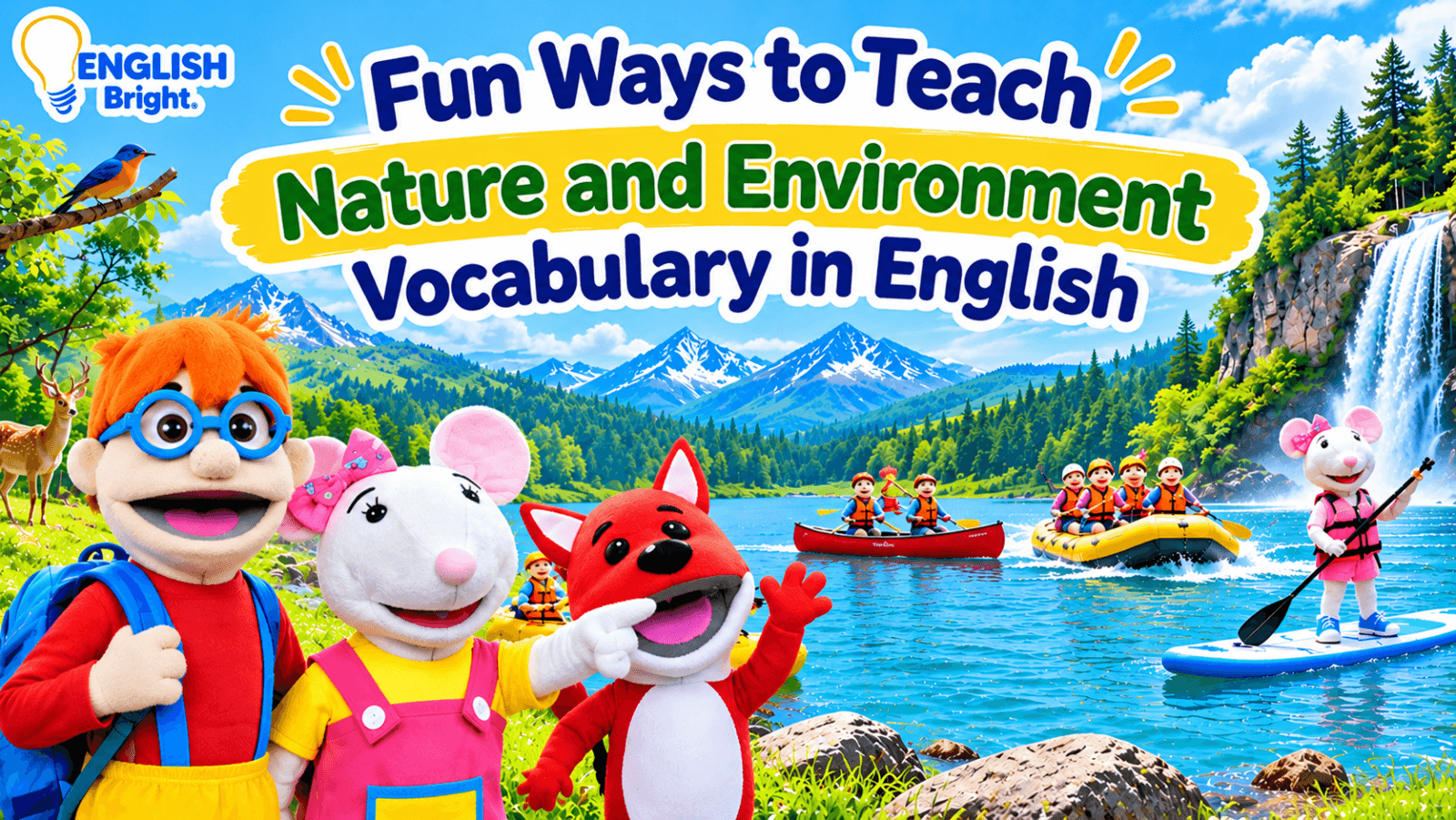
Nature is one of the most exciting topics for young English learners because it connects classroom learning with the world around them. From mountains and rivers to forests, oceans, and outdoor adventures, nature offers endless opportunities for students to discover new words and practice English in meaningful situations.
Teaching ESL nature vocabulary helps students describe their surroundings, talk about outdoor activities, and develop confidence in everyday English conversations. Instead of simply memorizing words, learners can explore nature through pictures, interactive games, speaking exercises, and real-life situations.
Whether you teach kindergarten, elementary students, or beginners in online ESL classes, incorporating nature vocabulary for kids can make English lessons more engaging and memorable.
In this article, we’ll explore fun ways to teach nature and environment vocabulary in English, including interactive activities and ready-to-teach lessons from English Bright ESL.
Why Teach Nature Vocabulary to ESL Students?
Learning nature vocabulary for ESL students helps children understand and describe the environment around them. Words such as river, mountain, ocean, forest, and lake are useful because students can recognize them in pictures, stories, videos, and real-life experiences.
Nature-themed lessons also encourage students to connect vocabulary with actions and experiences.
For example, students can practice sentences such as:
- “The river is long.”
- “I can see a mountain.”
- “The forest has many trees.”
- “We can swim in the lake.”
- “I want to go kayaking.”
These simple examples help students move beyond individual words and begin forming complete English sentences.
For English nature vocabulary for beginners, teachers should introduce familiar words first before moving into more specific topics, such as outdoor adventures, water sports, and environmental protection.

Introduce Nature Vocabulary With Pictures
One of the easiest ways to teach basic nature vocabulary in English is through colorful pictures and visual examples.
Young learners often understand new words more quickly when they can connect them to recognizable objects, places, and outdoor activities.
Start with common nature words and exciting water activities:
| Nature Vocabulary | Simple Meaning |
| Mountain | A very high area of land |
| River | Water that flows across the land |
| Ocean | A very large body of salt water |
| Forest | A place with many trees |
| Lake | Water surrounded by land |
| Beach | A sandy or rocky area beside water |
| Kayaking | Paddling a small boat called a kayak using a double-bladed paddle |
| Canoeing | Moving across water in a canoe using a paddle |
| Rafting | Traveling along a river in a raft, often through fast-moving water |
| Paddleboarding | Standing or kneeling on a board and using a paddle to move across water |
Teachers can introduce kayaking, canoeing, rafting, and paddleboarding using pictures from English Bright ESL’s Being with Nature lesson.
After showing each picture, encourage students to identify the activity and practice simple sentences:
- “I want to go kayaking on the lake.”
- “They are canoeing on the river.”
- “We are going rafting.”
- “She is paddleboarding in the ocean.”
Teachers can also ask questions such as “What are they doing?” or “Which water activity would you like to try?”
Using nature vocabulary with pictures helps students connect new English words with real-life outdoor experiences while developing their listening, speaking, and sentence-building skills.
Explore Outdoor Water Activities With English Bright ESL
Nature vocabulary becomes even more exciting when students learn how to use English to describe outdoor adventures.
English Bright ESL offers interactive, ready-to-teach lessons that help students connect vocabulary with practical conversations and engaging activities.
One exciting topic to explore alongside English Bright ESL’s Air Travel lesson is outdoor water activities.
In this nature-themed lesson, students explore the exciting world of outdoor water adventures, focusing on vocabulary such as kayaking, canoeing, rafting, and paddleboarding.
These activities introduce useful action words while encouraging students to describe experiences, express preferences, and discuss outdoor recreation.
Learn Outdoor Water Activity Vocabulary
Kayaking: Traveling across water in a kayak using a paddle.
Example: “I want to go kayaking on the lake.”
Canoeing: Traveling in a canoe using a paddle.
Example: “We are canoeing down the river.”
Rafting: Traveling along a river in a raft, sometimes through fast-moving water.
Example: “They are rafting on the river.”
Paddleboarding: Standing or kneeling on a board and using a paddle to move across water.
Example: “She enjoys paddleboarding at the beach.”
Teachers can show pictures of each activity and encourage students to describe what they see.
For example:
Teacher: “What are they doing?”
Student: “They are kayaking.”
Teacher: “Where can people go kayaking?”
Student: “They can go kayaking on a lake.”
This approach transforms ESL nature vocabulary activities into practical speaking exercises.
Connect Nature Vocabulary With Air Travel Conversations
English Bright ESL’s Air Travel lesson can also provide a useful connection between travel vocabulary and nature-themed discussions.
Students can imagine traveling by airplane to destinations where they can enjoy outdoor activities.
For example:
- “I want to fly to an island.”
- “I want to go rafting on a river.”
- “We can go paddleboarding at the beach.”
- “I want to visit a beautiful lake.”
By combining travel conversations with outdoor vocabulary, teachers can help students practice English through realistic situations.
Explore more ready-to-teach interactive resources in the English Bright ESL lesson library.
Practice Nature Vocabulary Through Matching Games
Matching games are excellent for helping beginners recognize and remember nature words in English.
Teachers can display pictures of mountains, forests, rivers, oceans, and outdoor activities alongside their corresponding vocabulary words.
Ask students to match each word with the correct picture.
For example:
- Mountain → Picture of a mountain
- River → Picture of flowing water
- Kayaking → Picture of someone paddling a kayak
- Rafting → Picture of people riding a raft
- Paddleboarding → Picture of someone standing on a paddleboard
For online ESL classes, teachers can use interactive slides, digital flashcards, or simple pointing activities.
To make the game more challenging, ask students to create a sentence after finding each match.
For example, after matching river, the student might say, “I can see a river.”
This encourages vocabulary recognition and sentence-building at the same time.
Use Nature-Themed Guessing Games
Guessing games make nature vocabulary lessons for kids more interactive and enjoyable.
Instead of showing students the answer immediately, describe a natural place or outdoor activity and ask them to guess.
For example:
Teacher: “It has many trees. Animals live there. What is it?”
Student: “A forest!”
Teacher: “You use a paddle and travel across water in a small boat. What activity is it?”
Student: “Kayaking!”
Other clues might include:
- “It is very high, and people can climb it.” — Mountain
- “It has sand and is beside the ocean.” — Beach
- “It is water that flows across the land.” — River
- “People stand on a board and use a paddle.” — Paddleboarding
These guessing games strengthen listening comprehension while encouraging students to recall vocabulary independently.

Encourage Students to Talk About Nature and Outdoor Adventures
Once students become familiar with nature vocabulary, encourage them to express their opinions and preferences.
Start with easy conversation questions:
- “Do you like the beach or the mountains?”
- “Have you ever visited a forest?”
- “Would you like to go kayaking?”
- “Which outdoor water activity looks exciting?”
- “What animals can you find in a forest?”
- “Would you rather visit a lake or an ocean?”
Beginners can respond with short answers, while more advanced students can explain their choices.
For example:
Teacher: “Would you like to try paddleboarding?”
Student: “Yes, I would.”
Teacher: “Why?”
Student: “Because it looks fun!”
These conversations help students develop confidence while using vocabulary in meaningful contexts.
Make Nature Vocabulary Lessons Interactive With English Bright ESL
Preparing engaging lessons doesn’t have to mean spending hours creating worksheets, flashcards, and games.
English Bright ESL provides web-based interactive resources designed to help teachers introduce vocabulary, practice sentence patterns, and encourage active participation.
Teachers can use its ready-to-teach materials to support:
- Picture-based vocabulary learning
- Interactive vocabulary games
- Simple sentence-building activities
- Listening and speaking practice
- Real-life English conversations
- Vocabulary review and reinforcement
The Air Travel lesson is especially useful for connecting travel-related English with conversations about destinations, outdoor adventures, and activities students might enjoy during a vacation.
Teachers can extend the lesson by introducing kayaking, canoeing, rafting, and paddleboarding, then asking students to plan their own imaginary outdoor adventure.
For example, students can describe where they want to travel, what natural places they want to see, and which activities they want to try.
This gives students a practical reason to use newly learned vocabulary.

Bring Nature Vocabulary Into Every ESL Classroom
Teaching ESL nature vocabulary is a wonderful way to help students connect English learning with the natural world.
From identifying mountains, rivers, and forests to describing exciting activities such as kayaking, canoeing, rafting, and paddleboarding, nature-themed lessons provide opportunities for vocabulary development, listening comprehension, and speaking practice.
By combining pictures, interactive games, sentence patterns, and real-life conversations, teachers can make English lessons more meaningful for beginners and young learners.
With English Bright ESL, teachers can explore ready-to-teach interactive lessons that make vocabulary learning more engaging and classroom preparation easier.
Less prep. More teaching.


Leave a Reply