
Teaching shapes is a fun and practical way to introduce young English learners to new vocabulary while encouraging them to observe and describe the world around them. A well-designed shapes lesson plan can combine vocabulary, pronunciation, counting, listening, speaking, movement, and games in one engaging class.
For preschool and beginner ESL students, shapes are especially useful because learners can see them everywhere. A clock can be a circle, a window can be a square, and a slice of pizza can look like a triangle. Instead of simply memorizing new words, students can learn to identify shapes and talk about what they see using simple English sentences.
Whether you need a lesson plan about shapes for preschool, a kindergarten shapes lesson, or a lesson plan for teaching shapes to complete beginners, the activities below can help you build an interactive class that develops both shape recognition and English communication skills.
Start With a Ready-to-Teach Shapes Lesson From English Bright ESL
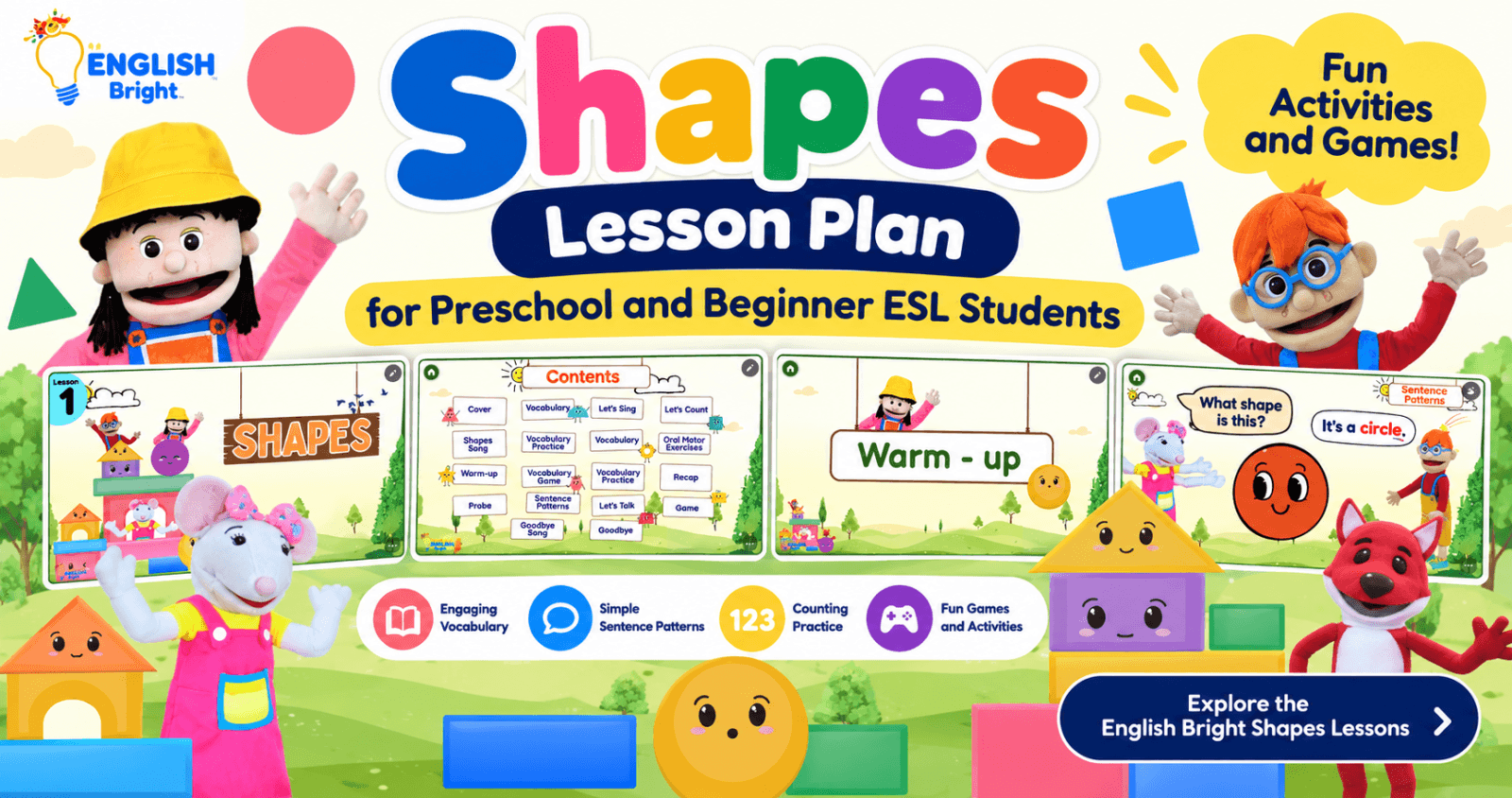
Teachers who want a structured approach can use English Bright ESL’s Shapes unit from Level 0 (Starter), Unit 2.
The complete unit contains 12 lessons, including review lessons and Knowledge Checks, giving beginner students multiple opportunities to learn, practice, and review shape vocabulary.
Rather than introducing a large number of shapes at once, the lessons gradually build students’ vocabulary and speaking skills through visuals, repetition, sentence patterns, pronunciation practice, counting, and interactive activities.
Sample Lesson: Shapes – Circle and Square

In Lesson 1, students begin with two common shapes:
circle and square
The lesson teaches students to recognize the shapes while also introducing useful beginner English sentence patterns:
What shape is it?
It is a circle.
It is a square.
These patterns are simple enough for preschool and complete beginner ESL students while encouraging them to move beyond one-word answers.
Students also practice counting shapes from 1 to 11, allowing teachers to reinforce numbers while teaching the new vocabulary.
Pronunciation practice is incorporated through oral motor exercises such as:
ci ci ci
and
squa squa squa
These exercises give young learners additional practice producing the sounds they need when saying the target shape words.
Teachers can explore the sample Shapes – Circle and Square lesson here:
Or discover all of the English Bright ESL Shapes lessons here: https://englishbrightesl.com/lesson/?_resource_type_filter=main-lesson&_level_category_filter=unit-2-shapes

Using a structured unit like this means teachers can introduce vocabulary, practice speaking, work on pronunciation, incorporate counting, review previous learning, and check understanding without having to prepare every activity separately.
Why Teach Shapes in an ESL Class?
Shapes may initially sound more like a math topic than an English lesson, but they provide plenty of opportunities for language development.
Students can learn vocabulary such as:
- circle
- square
- triangle
- rectangle
- oval
- star
- heart
- diamond
More importantly, they can use those words in simple conversations.
For example:
What shape is it?
It is a circle.
Is it a triangle?
Yes, it is.
What shape do you see?
I see a square.
Can you find a circle?
Yes! Here is a circle.
These short exchanges give students a clear reason to speak.
Rather than asking learners to memorize isolated vocabulary, an effective lesson plan for teaching shapes connects each new word with questions, answers, pictures, objects, and actions.
Learning Objectives for a Shapes Lesson Plan
Before starting the lesson, establish a few simple learning objectives.
By the end of the lesson, students should be able to:
- recognize common shapes
- name basic shapes in English
- identify shapes when shown pictures or real objects
- respond to simple questions about shapes
- use basic shape vocabulary in short sentences
- follow simple instructions involving shapes
- participate in shape-related games and speaking activities
For preschool students or complete beginners, avoid introducing too many shapes at once.
Start with two familiar shapes, such as circle and square, as demonstrated in the English Bright ESL sample lesson. You can then introduce triangle, rectangle, and other shapes as students become more confident.
1. Start With a Shapes Warm-Up
Begin your shapes lesson plan with something visual.
Hold up a circle or display one on the screen.
Ask:
What is this?
If students do not know the answer yet, introduce it yourself:
It is a circle. Circle.
Encourage students to repeat:
Circle!
Next, show a square.
It is a square. Square.
Students repeat:
Square!
For preschool students, add movement. Ask students to use their hands or fingers to create different shapes.
Make a circle with your hands!
Can you make a square?
Young learners benefit from connecting language with movement. It turns a basic vocabulary drill into a more active learning experience.
2. Introduce Shape Vocabulary With Clear Visuals
Visual support is especially important in a lesson plan about shapes for preschool students.
Show one large, clear shape at a time rather than placing too many unfamiliar shapes on the screen.
For example, show a circle and say:
Circle.
Have students repeat it.
Next, show a square:
Square.
Once students have heard and repeated the vocabulary several times, mix up the pictures.
Ask:
What shape is it?
Students answer:
It is a circle.
Then change the shape:
What shape is it?
It is a square.
This allows you to check whether students actually recognize the vocabulary rather than simply repeating the last word they heard.
3. Teach Simple Shape Sentence Patterns
Vocabulary becomes much more useful when students know how to put it into a sentence.
A great sentence pattern for preschool and beginner students is:
What shape is it?
It is a _____.
This is also the pattern used in the English Bright ESL Shapes lesson.
Model the exchange first:
Teacher: What shape is it?
Student: It is a circle.
Change the picture.
Teacher: What shape is it?
Student: It is a square.
Once students understand the pattern, increase the pace and randomly display different shapes.
You can later introduce another pattern:
What shape do you see?
I see a triangle.
Predictable sentence frames make speaking less intimidating because students already know most of the sentence and only need to change the shape vocabulary.
4. Play an Identify Shapes Game
Games are an excellent way to check understanding without making young learners feel like they are taking a test.
Place several shapes on the screen, board, or table.
Say:
Find the circle!
Students point to it.
Then:
Find the square!
As students become more confident, add more shapes.
You can also ask:
Is this a circle?
Students answer:
Yes, it is.
Or:
No, it isn’t.
Activities that require learners to identify shapes develop listening comprehension as well as vocabulary recognition.
For an online lesson, students can point, use an annotation tool, circle the answer, or tell the teacher where the correct shape is located.
5. Combine Shapes With Counting Practice
Shapes provide an easy opportunity to reinforce numbers.
Display several circles and ask:
How many circles are there?
Students count:
One, two, three, four…
Then ask:
How many squares are there?
The English Bright ESL sample lesson combines shape recognition with counting from 1 to 11, making it possible to practice two beginner skills in the same activity.
You can also ask:
Can you find three circles?
Can you count the squares?
How many shapes do you see?
This makes your shapes lesson more varied without introducing difficult new language.
6. Go on a Shape Hunt
Once students recognize the basic vocabulary, connect shapes to real objects.
Tell students:
Let’s find some shapes!
Students can look around the classroom or, during an online class, look around their room.
Ask:
Can you find a circle?
A student might point to a clock.
Then ask:
Can you find a square?
They might choose a window, picture frame, tile, or box.
Continue with other familiar shapes.
This activity works particularly well in a kindergarten shapes lesson because children discover that shapes are not limited to flashcards and lesson slides. Shapes are all around them.
Turn the activity into speaking practice by asking:
What shape is the clock?
Student:
It is a circle.
Teacher:
What shape is the window?
Student:
It is a square.
7. Match Shapes With Everyday Objects
Prepare pictures of familiar objects and ask students to match them with the correct shapes.
For example:
Circle: clock, coin, plate, wheel
Square: window, tile, box
Triangle: pizza slice, road sign, sandwich
Rectangle: door, book, phone, television
Students can drag pictures to the correct shapes in an interactive lesson or physically place picture cards into groups.
After matching, encourage them to speak.
Ask:
What shape is the plate?
Student:
The plate is a circle.
If a complete beginner responds with only:
Circle.
You can model the complete answer:
Yes! The plate is a circle.
This gently encourages students to progress from single-word responses to complete sentences.
8. Try a Draw-and-Guess Shapes Activity
Drawing provides another fun way to practice shape vocabulary.
Slowly draw part of a shape and ask:
What shape is it?
Students try to guess before you finish.
Is it a circle?
Is it a square?
Then reveal the answer.
You can also reverse the roles.
Tell the student:
Draw a circle.
After the student finishes, ask:
What shape did you draw?
The student answers:
I drew a circle.
With very young learners, do not worry about perfectly drawn shapes. The goal is English recognition and communication.
9. Build Pictures Using Shapes
Give students different shapes and challenge them to create a picture.
For example, they could use:
- a square for a house
- a triangle for the roof
- a rectangle for the door
- circles for windows
- circles and triangles to create people or animals
While students build their pictures, continue asking questions.
What shape do you need?
How many circles do you see?
Where is the triangle?
You can also combine shapes with colors and positional vocabulary.
For example:
Put the red triangle above the square.
Put the blue circle next to the rectangle.
Now students are practicing shapes, colors, listening comprehension, and location words at the same time.
10. Play a Mystery Shape Game
Once students become familiar with the vocabulary, give them clues without saying the shape’s name.
For example:
It is round. What shape is it?
Students answer:
A circle!
Or:
It has three sides. What is it?
Students answer:
A triangle!
Keep clues short and visual for preschool beginners.
More confident learners can eventually take the teacher’s role and give clues to their classmates.
11. Review With Quick Shape Questions
End the lesson with a short review.
Display different shapes and ask quick questions such as:
What shape is it?
Is this a circle?
Where is the square?
Can you find a triangle?
What shape do you see?
How many circles are there?
Keep the review energetic and positive. Students can earn stars or points for correct answers, or you can simply celebrate each successful response.
The goal is to determine whether students can independently identify shapes and use the target vocabulary in a simple sentence.
Sample 30-Minute Shapes Lesson Plan
Here is one way to organize a 30-minute class:
Warm-Up – 3 minutes
Introduce the topic with familiar objects and shapes.
Shape Vocabulary – 5 minutes
Introduce circle, square, triangle, and rectangle.
Sentence Pattern – 5 minutes
Practice What shape is it? It is a ____.
Identify Shapes Game – 4 minutes
Students listen and choose the correct shape.
Counting Shapes – 3 minutes
Count circles, squares, and other shapes together.
Shape Hunt – 4 minutes
Find shapes around the classroom or home.
Speaking Activity – 3 minutes
Ask and answer questions about everyday objects.
Review – 3 minutes
Use quick questions to review vocabulary and sentence patterns.
You can shorten or extend each section depending on the student’s age, attention span, and English level.
Tips for Teaching Shapes to Preschool ESL Students
When developing a lesson plan for teaching shapes, keep your instructions short, visual, and repetitive.
Preschool students do not need long explanations about the mathematical properties of shapes. They need opportunities to:
see it → hear it → say it → find it → use it
Show students the shape.
Say its name.
Have them repeat it.
Ask them to find it.
Finally, encourage them to use it in a sentence.
For example:
Circle.
Find the circle.
What shape is it?
It is a circle.
Repeating the same vocabulary in different activities strengthens comprehension without making the lesson feel repetitive.
Movement is also valuable. Encourage students to point, touch, trace, draw, count, match, find, and create shapes.
Most importantly, include frequent opportunities for speaking.
Instead of only asking students to click on a circle, ask:
What shape is it?
Instead of simply matching a clock with a circle, ask:
What shape is the clock?
Small speaking opportunities throughout a kindergarten shapes lesson can transform basic shape recognition into meaningful English practice.
Make Shapes Easier to Teach With English Bright ESL
Teachers do not have to create every vocabulary slide, speaking activity, review exercise, and assessment from scratch.
English Bright ESL provides web-based interactive ESL lessons that teachers can open and teach directly from their browser.
The Level 0 Shapes unit provides a structured sequence of 12 lessons, including review and Knowledge Checks, allowing teachers to introduce shapes gradually and reinforce what students have learned.
The sample Circle and Square lesson demonstrates how several beginner skills can be integrated naturally into one class. Students learn shape vocabulary, practice the sentence patterns What shape is it?, It is a circle, and It is a square, count shapes from 1 to 11, and work on pronunciation through oral motor exercises.
This approach helps young learners do more than memorize vocabulary. They repeatedly hear, recognize, say, and use English throughout the lesson.
Teachers can explore the full Shapes unit and use the lessons as part of their preschool, kindergarten, or beginner ESL classes.
Final Thoughts
A successful Shapes Lesson Plan for Preschool and Beginner ESL Students should be visual, simple, repetitive, and highly interactive.
Begin with familiar shapes such as circle and square. Give students plenty of opportunities to hear and repeat the vocabulary before asking them to identify shapes independently.
From there, introduce simple sentence patterns such as:
What shape is it?
It is a circle.
Combine these patterns with counting, shape hunts, matching games, drawing, real-world objects, and interactive activities.
Whether you are developing your own lesson plan about shapes for preschool, preparing a kindergarten shapes lesson, or using the ready-to-teach Shapes unit from English Bright ESL, the goal should go beyond teaching children the names of shapes.
When students can identify shapes, understand questions about them, and confidently describe what they see in English, a simple shapes lesson becomes an opportunity to build vocabulary, pronunciation, listening comprehension, and speaking confidence.


Leave a Reply