
Getting students to speak English confidently can be one of the most rewarding—and sometimes challenging—parts of teaching ESL. A student may understand vocabulary, recognize grammar rules, and complete reading exercises successfully, yet suddenly become quiet when it is time to speak.
That is why effective ESL speaking activities are so important.
Speaking practice gives learners opportunities to turn the English they understand into English they can actually use. Instead of simply memorizing words or completing worksheets, students practice asking questions, responding naturally, describing ideas, sharing opinions, and communicating with other people.
The best speaking activities do not have to be complicated. Simple questions, pictures, games, sentence patterns, role-plays, and interactive lessons can encourage students to speak more frequently and with greater confidence.
Whether you teach children, teenagers, adults, beginners, or advanced learners, these fun and engaging ESL speaking activities can help turn a quiet English class into an active conversation.
Why ESL Speaking Activities Matter
Students need more than knowledge of English—they need opportunities to use it.
A learner might know that apple is a fruit or understand how the present tense works. However, speaking requires the learner to retrieve that knowledge, organize it into a sentence, pronounce the words, and respond in real time.
Regular ESL speaking practice activities help learners develop these skills gradually.
Speaking activities can help students:
- use new vocabulary in context
- practice complete sentence patterns
- improve pronunciation
- respond to questions more naturally
- develop conversational fluency
- organize their thoughts in English
- become more comfortable expressing ideas
- build confidence when communicating
This is especially important for students who tend to give one-word answers.
Instead of accepting:
Teacher: What food do you like?
Student: Pizza.
Encourage the learner to expand:
Student: I like pizza because it is cheesy and delicious.
One small change turns vocabulary recall into meaningful speaking practice.

Start With Simple Question-and-Answer Activities
Question-and-answer practice is one of the easiest ESL speaking activities for beginners because it gives students a clear structure while still encouraging them to express their own ideas.
Instead of asking students to memorize isolated words, introduce useful vocabulary and then immediately turn it into a conversation. This helps learners connect new words with meaningful speaking practice.
For example, an English Bright ESL lesson on physical descriptions introduces the vocabulary words big and small. Students learn how to describe size and practice expressing preferences with the sentence pattern:
Would you rather be big or small?
The lesson also introduces the action words fit and stretch, along with the sight words it, would, grow, and look. Grammar practice focuses on gerunds, while phonics activities introduce the -er sound to support clearer pronunciation.
Once students are familiar with the language, the lesson moves beyond vocabulary recognition and encourages them to talk about their own ideas.
A simple speaking prompt is:
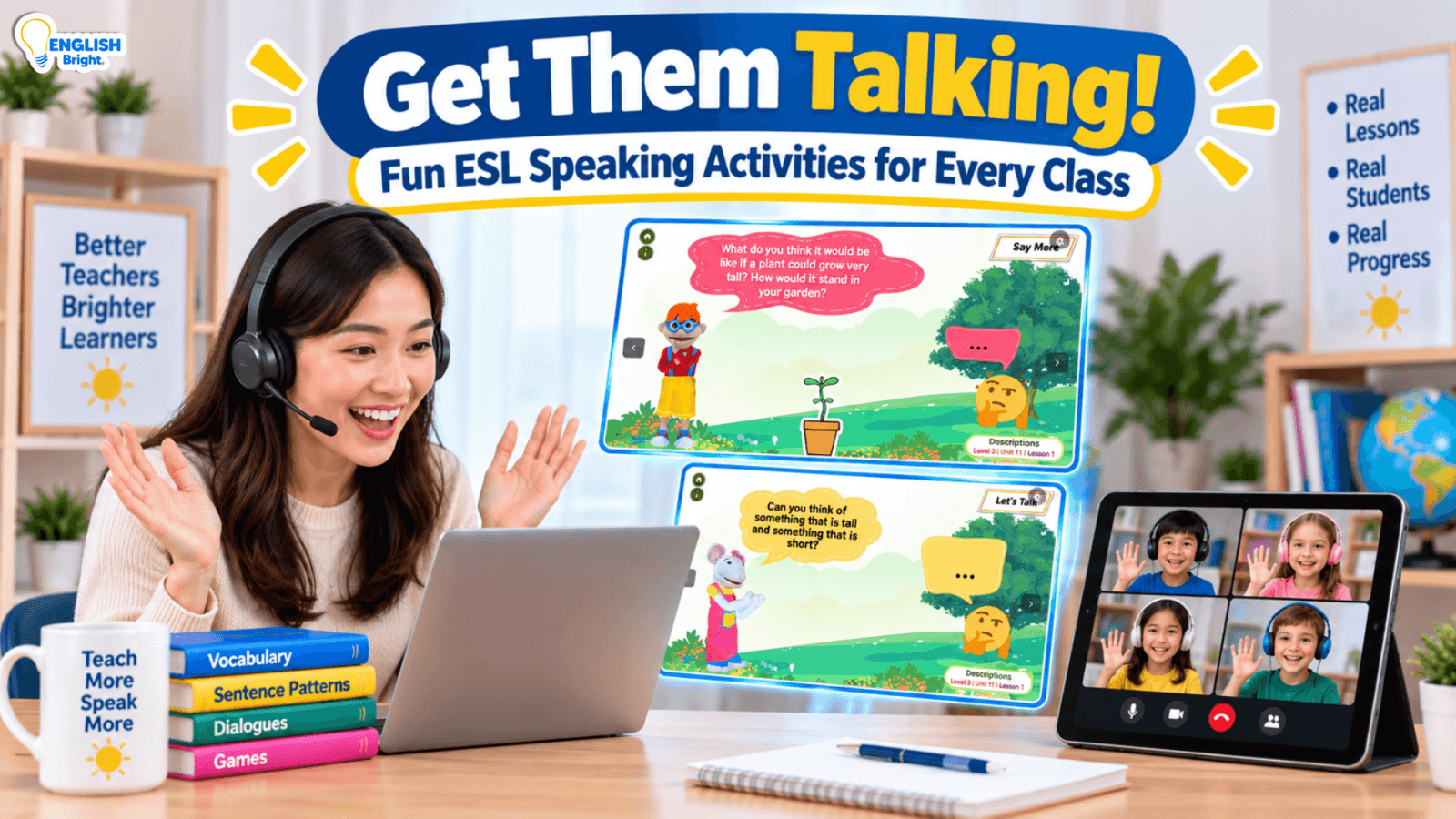
Can you tell me about one big animal and one small animal?
A beginner might answer:
An elephant is big. A mouse is small.
The teacher can then extend the conversation:
Which animal is bigger?
Which animal would you rather see?
Why?
Can you think of another small animal?
Students can also respond to more imaginative questions, such as:
What do you think it would be like if a plant could grow very tall? How would it stand in your garden?
These open-ended prompts encourage learners to move beyond one-word answers and begin explaining, imagining, and sharing opinions in English.
This is where English Bright ESL makes speaking practice especially useful. Vocabulary, sentence patterns, grammar, phonics, sight words, and speaking prompts are connected within the same interactive lesson, so students first build the language they need and then actually use it to communicate.
For teachers looking for fun ESL speaking activities, this approach provides both structure and flexibility. Beginners can answer with simple sentences, while stronger students can be challenged with follow-up questions that require longer responses.
Teacher Tip: Don’t stop after the student’s first correct answer. Ask one or two natural follow-up questions. Turning An elephant is big into Why do you think elephants need such big bodies? can transform a vocabulary exercise into genuine ESL speaking practice.

Use Pictures to Get Students Talking
Pictures are excellent prompts for interactive ESL speaking activities, particularly with children and visual learners.
Show students an interesting picture and ask them to describe what they notice.
Beginners might answer:
I see a boy.
The dog is brown.
There are three trees.
Intermediate learners can provide more detail:
The boy is playing outside with his dog. It looks sunny, so they might be at a park.
Advanced learners can infer, predict, or create stories:
I think the family is preparing for a picnic because they have a basket and several bags of food.
Teachers can use questions such as:
What can you see?
Where are they?
What is happening?
How does the person feel?
What happened before this picture?
What do you think will happen next?
The same picture can therefore become an activity for several proficiency levels.
Practice Speaking With English Bright ESL
Teachers do not always have time to create new speaking prompts, visuals, vocabulary activities, sentence patterns, and games for every class.
English Bright ESL makes speaking practice easier by providing interactive, browser-based ESL lessons that teachers can open and teach without relying on stacks of PDFs or preparing multiple resources before class.
The curriculum includes Levels 0–7 and supports learners from young beginners through more advanced English students.
Speaking is integrated naturally with other language skills through:
- interactive vocabulary
- sentence patterns
- dialogues
- reading and comprehension
- phonics
- grammar
- sight words
- stories
- games
- pronunciation practice
- speaking activities
For example, students might first learn vocabulary visually and hear how words are pronounced. They can then use those words in structured sentence patterns before moving into questions, dialogues, or freer conversation.
This progression is useful because students are not simply told, “Now speak English.”
They are given the language they need before they are expected to use it.
For teachers searching for ready-to-use speaking activities for ESL, this can make lessons much easier to manage while giving students more opportunities to actively use English.
Visit EnglishBrightESL.com to explore interactive ESL lessons and speaking resources.
Turn Vocabulary Into Speaking Practice
Vocabulary does not have to end with naming flashcards.
Once students recognize a new word, immediately encourage them to use it.
Imagine that students are learning food vocabulary:
apple, pizza, rice, chicken, soup
Instead of only asking:
What is this?
continue with:
Do you like soup?
How often do you eat rice?
What is your favorite pizza topping?
Which food would you choose for dinner? Why?
This approach turns vocabulary review into ESL speaking practice activities.
For younger students, keep questions concrete and simple. For intermediate and advanced students, ask learners to explain preferences, compare options, or justify their answers.
Try Role-Plays for Real-Life English
Role-play allows students to practice English they may actually need outside the classroom.
Possible situations include:
- ordering at a restaurant
- shopping for clothes
- asking for directions
- checking into a hotel
- making an appointment
- meeting someone new
- talking to a classmate
- visiting a doctor
Before starting, provide useful expressions.
For a restaurant activity:
I’d like ___, please.
Can I have ___?
How much is ___?
Could I have the bill, please?
Students can first practice the dialogue with support and then repeat the role-play with less guidance.
This works particularly well for ESL speaking activities for adults because teachers can choose scenarios connected to work, travel, shopping, appointments, and everyday communication.
Use Speaking Games With Kids and Young Learners
ESL speaking activities for kids should include plenty of interaction, variety, and opportunities for repetition.
Games can provide repetition without making practice feel repetitive.
Try a guessing game.
One student describes an animal:
It is big.
Another student answers:
Is it an elephant?
You can do the same with food, jobs, transportation, household objects, countries, clothing, or classroom vocabulary.
For ESL speaking activities for young learners, use short turns and clear sentence patterns. Children do not necessarily need long conversations. Frequent, successful speaking turns can be more valuable.
Create Information-Gap Activities
Information-gap tasks give students a genuine reason to communicate.
Student A has information Student B does not have, and vice versa. They must speak to complete the activity.
For example, each student might have a weekly schedule with missing information.
Student A asks:
What does Emma do on Tuesday?
Student B checks the schedule and responds:
She plays tennis on Tuesday.
This makes speaking purposeful. Students are communicating to discover information rather than simply repeating a sentence because the teacher told them to.
Ask Intermediate Students to Explain and Compare
ESL speaking activities for intermediate students should gradually move beyond basic answers.
Ask learners to compare two things:
Which is better: studying online or studying in a classroom?
Would you rather live in a city or the countryside?
Which is more important: having a high-paying job or enjoying your job?
Encourage useful phrases:
I think ___ because…
In my opinion…
One advantage is…
On the other hand…
I agree because…
I disagree because…
These activities develop both speaking fluency and critical thinking.
Challenge Advanced Students With Discussions
ESL speaking activities for advanced students should encourage learners to explain complex ideas, defend opinions, react to other viewpoints, and speak for longer periods.
Discussion topics might include:
Should students use AI for schoolwork?
Is social media improving or damaging communication?
Should people work four days a week instead of five?
Is living abroad the best way to learn another language?
Instead of focusing only on grammatical accuracy, encourage students to maintain the conversation.
Teach phrases such as:
I see your point, but…
From my perspective…
Another way of looking at it is…
Could you explain what you mean by…?
I partly agree because…
These expressions make conversations feel more natural and help advanced learners develop stronger discussion skills.
Retell a Short Story
Story retelling combines reading comprehension and speaking.
After students read or listen to a short story, ask them to explain what happened using their own words.
Provide transition phrases:
At the beginning…
Next…
After that…
Finally…
Beginners might retell the story using three or four simple sentences, while advanced learners can include details, character motivations, causes, consequences, and opinions.
English Bright ESL lessons can support this type of connected learning by combining vocabulary, reading, comprehension, sentence building, and speaking within a lesson sequence.
Students are not practicing each skill in isolation. They can use vocabulary and language structures they have already encountered to talk about what they have understood.
Finish With a One-Minute Speaking Challenge
A one-minute challenge is an easy way to end a lesson.
Give students a familiar topic:
My family
My favorite food
My weekend
My dream vacation
My favorite animal
A place I want to visit
Beginners can start with 20–30 seconds.
As their confidence increases, extend the time.
Teachers can also provide three prompts:
What is it?
Why do you like it?
Tell me something interesting about it.
The goal is not perfect grammar. The goal is to keep communicating.

Make ESL Speaking Activities Part of Every Lesson
Students become better speakers by speaking.
Fortunately, teachers do not need to turn every class into a long conversation lesson. Even a few minutes of purposeful speaking can make vocabulary, grammar, reading, and pronunciation lessons more communicative.
Start with structured questions for beginners. Use pictures and games with children. Introduce role-plays for practical communication. Encourage intermediate students to explain their opinions, and challenge advanced learners with discussions and extended responses.
Most importantly, give students language they can actually use.
English Bright ESL helps teachers make this easier by bringing vocabulary, sentence patterns, dialogues, reading, pronunciation, games, and speaking practice together in interactive, ready-to-teach lessons.
Instead of spending hours creating separate materials, teachers can open a lesson and focus more of their energy on what matters: interacting with students and getting them to speak.
Whether you need ESL speaking activities for beginners, ESL speaking activities for adults, ESL speaking activities for kids, or more challenging conversation practice, the key is the same:
Give learners a reason to speak, give them the language to do it, and give them plenty of opportunities to try.
Explore ready-to-teach interactive lessons at English Bright ESL and get your students talking more in every English class.


Leave a Reply