
Halloween is the perfect time to bring a little extra excitement into English lessons. Pumpkins, costumes, candy, witches, and spooky characters give teachers plenty of opportunities to introduce new vocabulary and encourage students to speak.
One of the easiest ways to turn these themes into meaningful language practice is through Halloween games.
Instead of simply memorizing a list of Halloween words, students can identify pictures, make choices, answer questions, describe characters, and use new vocabulary while playing. For young learners especially, a pumpkin-themed game can make an English lesson feel more like a Halloween celebration.
Teachers can use interactive Halloween games for ESL students in traditional classrooms, one-on-one lessons, and online classes. From carving a virtual pumpkin to matching Halloween pictures and guessing mystery words, there are plenty of ways to combine learning with seasonal fun.
Play Let’s Carve a Pumpkin With English Bright ESL
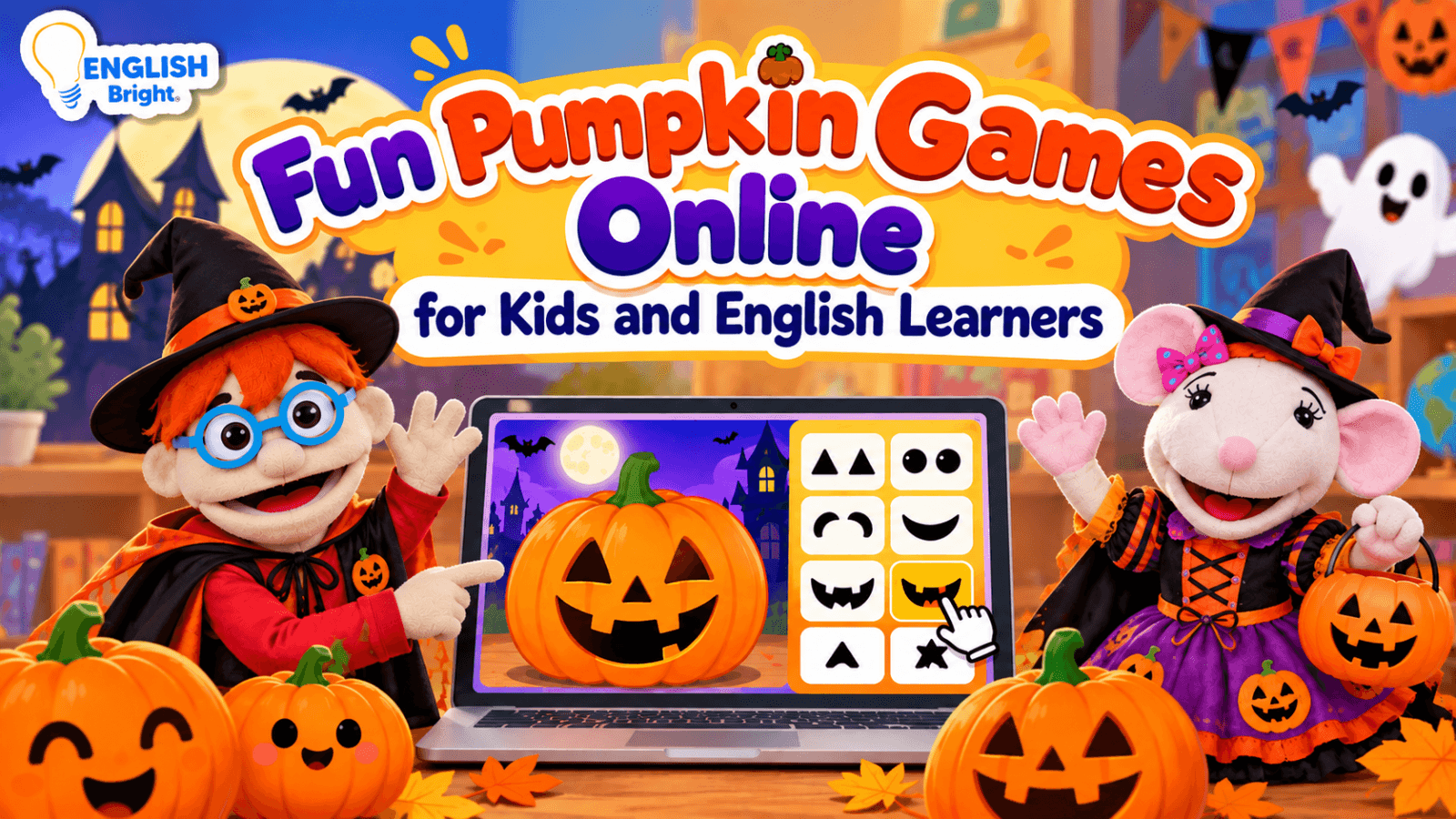
A great place to start is the English Bright ESL Halloween Cultural Celebration lesson, which includes an interactive activity called Let’s Carve a Pumpkin.
Rather than simply looking at a picture of a jack-o’-lantern, students get to participate in creating one.
During the activity, learners can choose different features for their pumpkin, such as the eyes, nose, and mouth. Each choice changes the pumpkin’s appearance and gives teachers an opportunity to turn a simple Halloween game into an English conversation.
For example, teachers can ask:
Which eyes do you like?
What kind of mouth should we choose?
Is your pumpkin happy or scary?
What color is the pumpkin?
Does your pumpkin look funny?
Which one should we choose next?
Students can answer with short sentences such as:
I like these eyes.
I want this mouth.
My pumpkin is scary.
It has a funny face.
For beginners, even simple responses like “This one!” or “Scary!” can become a starting point for longer speaking practice.
The teacher can model the complete sentence and encourage the learner to repeat it.
Student: This one!
Teacher: Great! I want these eyes.
Student: I want these eyes.
This makes Let’s Carve a Pumpkin more than just a seasonal game. It becomes an interactive speaking and vocabulary activity that can be adapted to different English levels.

Turn Pumpkin Carving Into a Speaking Game
Virtual pumpkin carving can easily become one of your Halloween speaking games for ESL students.
Instead of allowing students to immediately select a pumpkin feature, ask them to describe their choice first.
A beginner might say:
I want big eyes.
An intermediate learner could expand the idea:
I want the big eyes because they make the pumpkin look scary.
Stronger students can compare choices:
I prefer the second mouth because it looks funnier than the first one.
This simple adjustment creates more opportunities for students to produce meaningful language.
Teachers looking for Halloween speaking activities for kids can also ask students to describe their completed pumpkin. Encourage them to talk about its eyes, nose, mouth, expression, and personality.
They could even give the pumpkin a name and create a short story about it.
Practice Halloween Vocabulary Through Games
Pumpkin activities also work well as Halloween vocabulary games for ESL students because the theme connects naturally with common seasonal words.
Depending on the student’s level, introduce words such as:
pumpkin, eyes, nose, mouth, face, orange, scary, funny, happy, Halloween, costume, candy, witch, bat, and ghost.
After introducing the vocabulary, use it throughout the game rather than practicing each word separately.
Ask:
Where is the pumpkin?
Can you find the scary face?
What does the pumpkin have?
Is the mouth big or small?
For younger students, repetition is especially useful. Hearing and using the same vocabulary several times during an interactive activity can help make unfamiliar words easier to remember.
These kinds of Halloween vocabulary games for kids also give words a visual context. Students are not only hearing the word pumpkin; they are looking at one, changing its appearance, and talking about it.
Try a Halloween Pumpkin Guessing Game
Another easy activity is a pumpkin guessing challenge.
Create or display several different pumpkin faces. One student secretly chooses a pumpkin while the other student asks questions to identify it.
Questions might include:
Does it have big eyes?
Is it smiling?
Does it look scary?
Does it have a small mouth?
Is it happy?
The student can respond:
Yes, it does.
No, it doesn’t.
This transforms Halloween guessing games for kids into useful question-and-answer practice.
For beginners, teachers can provide sentence starters on the screen. More confident students can create their own questions.
Play Halloween Pumpkin Matching Games
Matching activities are another simple way to practice Halloween English.
Teachers can create pairs using a picture and a word, two identical pumpkin faces, or a pumpkin and its matching description.
For example:
scary pumpkin → picture of a scary pumpkin
happy pumpkin → picture of a smiling pumpkin
pumpkin → pumpkin picture
witch → witch picture
bat → bat picture
These Halloween matching games for kids work particularly well with beginners because students can rely on visual clues while learning new words.
Matching can also become a speaking task. Before a student makes a match, require them to say the word or use it in a sentence.
Instead of simply clicking a pumpkin, the learner might say:
I see a pumpkin.
Now the game combines vocabulary recognition, pronunciation, and speaking.
Play Halloween Word Games for Kids
Once students know some basic Halloween vocabulary, add simple word challenges.
For example, show a picture and ask students to unscramble:
PKUMPIN
Students rearrange the letters to make:
PUMPKIN
You can do the same with words such as:
GHOST
BAT
WITCH
CANDY
MASK
Another option is a Halloween category challenge. Give students 30 seconds to name as many Halloween words as possible.
These Halloween word games for kids are easy to adapt for different ability levels and can be played in person or through screen sharing.

Use Pumpkin Games With Kindergarten and Young Learners
The best Halloween games for young learners should have simple instructions, strong visuals, repetition, and plenty of opportunities to participate.
With very young students, avoid turning every activity into a difficult vocabulary test. Instead, use short instructions such as:
Choose the eyes.
Find the pumpkin.
Point to the mouth.
Make it scary!
Choose one.
For Halloween games for kindergarten students, teachers can also add movement. Students might make a scary face when they see a scary pumpkin or pretend to carve a pumpkin using their hands.
This combination of visuals, movement, and repetition keeps younger learners involved while exposing them to useful English.
Make Pumpkin Games More Challenging for Elementary Students
Older children can handle more language during the same activities.
For Halloween games for elementary students, ask learners to explain their choices, compare pumpkins, write descriptions, or create short stories.
After completing a pumpkin, a student might write:
My pumpkin is called Mr. Spooky. He has big triangle eyes and a funny mouth. He lives outside a haunted house.
Students could then present their pumpkins to the class.
Another option is to have classmates vote on categories such as the funniest, happiest, strangest, or most creative pumpkin.
This turns a simple game into a combination of speaking, listening, reading, and writing practice.
Use Pumpkin Games in Online ESL Classes
These activities are especially useful for teachers searching for Halloween games for online classes.
With screen sharing and interactive digital materials, students can participate without needing printed worksheets or complicated supplies.
During Halloween games for online ESL classes, teachers can let students make choices, answer questions, describe what they see, and predict what will happen next.
A virtual pumpkin activity works particularly well because the student has a clear visual focus throughout the lesson.
Teachers can also use a pumpkin game as a warm-up before a Halloween lesson or as a reward after completing another activity.
Bring Pumpkin Games Into the Classroom
Online activities are not limited to online teaching.
Teachers can display digital Halloween classroom games for English learners on an interactive whiteboard or classroom screen. Students can take turns making choices while the rest of the class answers questions or describes what is happening.
For example, one student chooses the pumpkin’s eyes.
The class says:
The pumpkin has big eyes!
Another student chooses the mouth.
Everyone responds:
The pumpkin has a scary mouth!
These simple Halloween games for the classroom encourage group participation without requiring teachers to prepare large amounts of additional material.
They can also become easy Halloween party games for kids when teachers want a classroom celebration that still includes an educational element.
Combine Fun and Learning This Halloween
The best Halloween educational games for kids do not need to feel like traditional study activities.
A simple pumpkin game can practice vocabulary, listening, pronunciation, sentence building, describing, comparing, and conversation.
Teachers can also combine several activities into one Halloween lesson:
- Introduce pumpkin and Halloween vocabulary.
- Play Let’s Carve a Pumpkin.
- Ask students to describe their finished pumpkin.
- Play a pumpkin guessing game.
- Finish with a Halloween word or matching game.
This creates a complete lesson from several short Halloween learning games for kids while keeping one clear theme throughout the class.

Make Halloween English Practice More Interactive
There are countless fun Halloween activities and games for kids, but the most useful ESL activities give students a reason to actually use English.
Pumpkin games are particularly versatile because teachers can make them as simple or challenging as their students need.
Young beginners can identify eyes, mouths, colors, and emotions. Elementary students can describe and compare pumpkin faces. More advanced learners can explain their choices, invent characters, and create Halloween stories.
For teachers searching for online Halloween games for ESL students or fun Halloween games for English class, interactive activities can make seasonal lessons more memorable without requiring hours of preparation.
With English Bright ESL’s Halloween Cultural Celebration activities, including Let’s Carve a Pumpkin, teachers can bring Halloween fun directly into their lessons while encouraging students to listen, choose, describe, and speak.
This Halloween, don’t just show students a pumpkin.
Let them build one, describe it, talk about it, and learn English while they play.



Leave a Reply