
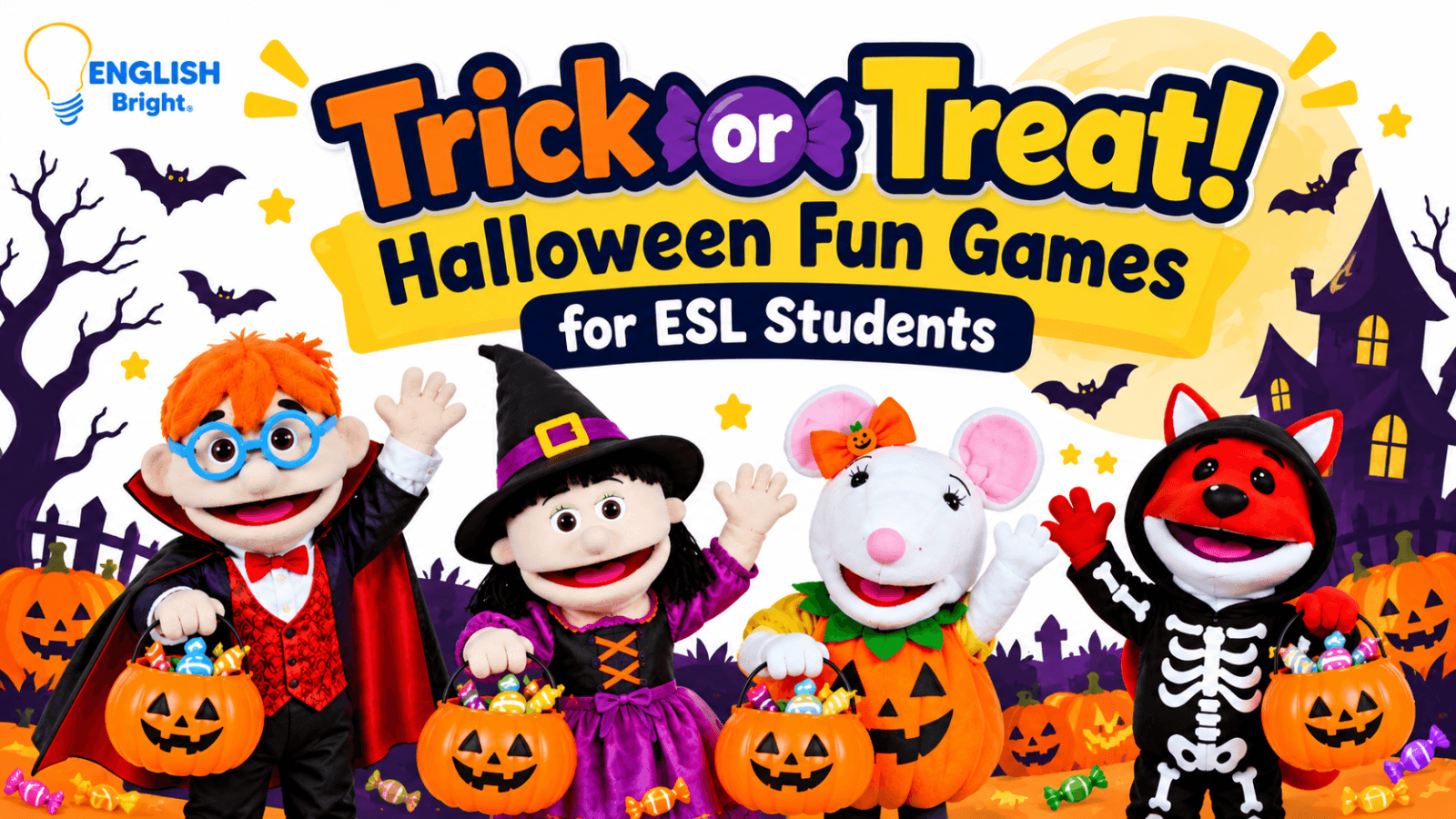
Halloween is the perfect time to turn English practice into something students genuinely look forward to. Costumes, candy, pumpkins, and the familiar words “Trick or treat!” give ESL teachers plenty of opportunities to encourage vocabulary practice and speaking without making the lesson feel like another exercise.
One of the easiest ways to bring that excitement into class is through Halloween fun games based on trick-or-treating.
Instead of introducing several unrelated Halloween activities, teachers can take one familiar tradition and use it in different ways throughout the lesson. Students can knock on pretend doors, ask for treats, identify Halloween vocabulary, answer questions, and practice short conversations.
English Bright ESL makes this especially easy with its Halloween Cultural Celebration lessons, which combine seasonal vocabulary and English practice with interactive Trick-or-Treat activities. Teachers can use these lessons to introduce Halloween traditions while giving students plenty of opportunities to participate.
Let’s explore how to turn Trick-or-Treat into a fun, interactive English lesson.
Start With the English Bright ESL Halloween Cultural Lesson
Before playing a Trick-or-Treat game, students need enough language to understand what is happening.
The English Bright ESL Halloween Cultural Celebration lessons introduce learners to Halloween through age-appropriate vocabulary, sentence practice, visuals, and interactive activities.
This gives teachers a natural starting point.
Introduce key Halloween words first. Depending on the lesson and level, students may encounter familiar Halloween ideas such as:
Halloween
costume
candy
pumpkin
witch
ghost
bat
Students can listen, repeat, identify pictures, and practice using the words aloud.
Once they are familiar with the vocabulary, move into the Halloween tradition at the center of the lesson: Trick-or-Treat.
Explain the tradition simply:
On Halloween, children wear costumes. They visit houses and say, “Trick or treat!” People give them candy.
For beginners, that short explanation is enough. The goal is not to give students a long cultural lecture. Instead, help them understand the tradition so they can start using English while playing.
Then comes the fun part.

Play Trick-or-Treat Games With English Bright ESL
The Trick-or-Treat activities in the English Bright ESL Halloween lessons turn a familiar Halloween tradition into interactive language practice.
Instead of simply learning about trick-or-treating, students can take part in a Halloween-themed activity themselves.
These Halloween fun games for ESL students work especially well for online classes because learners can interact with the lesson directly on screen. At the same time, teachers can use each part of the activity to encourage conversation and vocabulary practice.
Before beginning the game, introduce the most important expression:
“Trick or treat!”
Make pronunciation practice more playful by encouraging students to try different voices. They could whisper the phrase like a ghost, squeak it like a tiny mouse, or use a deep voice like a scary monster. For another round, challenge them to sound like an excited child going trick-or-treating for the first time.
This quick warm-up helps younger learners become comfortable saying the expression while adding some Halloween fun to the lesson.
Once everyone is familiar with the phrase, move on to the interactive Trick-or-Treat activity.
Every new turn provides another opportunity to use English. Instead of moving quickly through the activity, pause at different moments and encourage learners to describe what they see, repeat useful vocabulary, or answer a simple question.
By adding these short speaking challenges, teachers can transform a fun Halloween activity into meaningful English practice.
Turn Every Trick-or-Treat Turn Into a Speaking Challenge
The secret to getting more value from interactive Halloween games for ESL students is to build short speaking challenges into the activity.
Whenever something new appears on screen, pause for a moment and encourage students to talk about it. Simple questions work well:
What do you see?
What color is it?
Is it scary?
Do you like it?
What do you think will happen next?
Beginners do not need to give complicated answers. A learner might simply respond:
“A pumpkin.”
From there, the teacher can model a complete sentence:
“Yes! It is a pumpkin.”
Encourage the learner to repeat the sentence before continuing with the Trick-or-Treat activity.
For stronger students, turn the same moment into a short conversation:
Teacher: What do you see?
Student: I see a pumpkin.
Teacher: What color is the pumpkin?
Student: It is orange.
Next, continue with a preference question:
Teacher: Do you like pumpkins?
Student: Yes, I do!
Adding different types of questions keeps the conversation moving without making the activity feel like a speaking test. Students enjoy the excitement of the game while practicing vocabulary, sentence patterns, descriptions, and personal responses.
With a few well-timed questions, Trick-or-Treat becomes one of the easiest Halloween speaking games for ESL students to adapt for different ability levels.

Use Trick-or-Treat for Halloween Vocabulary Practice
Trick-or-Treat can also become one of your Halloween vocabulary games for ESL students.
Before students take their next turn, give them a quick vocabulary challenge.
For example:
Name three Halloween words.
A learner might answer:
Pumpkin. Candy. Costume.
Then continue the game.
On the next turn, change the challenge:
What do you wear on Halloween?
A costume!
Another turn:
What do children get when they go trick-or-treating?
Candy!
Another:
What do children say at the door?
Trick or treat!
Because students want to continue playing, these tiny challenges give them a reason to retrieve vocabulary quickly.
For Halloween games for ESL beginners, make the questions visual whenever possible. Show two pictures and ask students to choose the correct one.
Which one is the pumpkin?
Which one is the costume?
Where is the candy?
Students can point, click, or say the word aloud.
The activity stays accessible while still reinforcing English.
Create a Trick-or-Treat Role-Play
After students understand how trick-or-treating works, bring the tradition into a short role-play.
You do not need elaborate props or decorations.
The teacher can pretend to be inside a house while the student approaches the imaginary door.
Student: Knock, knock!
Teacher: Hello!
Student: Trick or treat!
Teacher: Happy Halloween! Here is some candy.
Student: Thank you!
Then switch roles.
The student becomes the person answering the door, and the teacher becomes the trick-or-treater.
Once students are comfortable with the basic conversation, add questions.
Teacher: What is your costume?
Student: I am a witch.
Teacher: What candy do you like?
Student: I like chocolate.
Teacher: How many candies do you want?
Student: I want three candies.
Now one Trick-or-Treat activity is practicing vocabulary, greetings, numbers, preferences, questions, and complete sentences.
That makes it useful for teachers searching for fun Halloween games for students that include real speaking practice.

Make Trick-or-Treat Easier for ESL Beginners
Beginners should not have to create every sentence independently.
Give them simple sentence frames they can reuse throughout the activity:
Trick or treat!
I see a _____.
It is a _____.
I like _____.
I want _____.
Thank you!
Display the patterns where students can see them.
During the first few turns, model each response. Gradually reduce your support as the learner becomes more confident.
For very young students, even one-word responses are a useful starting point.
If you ask:
What is it?
and the student says:
“Candy!”
accept the answer and model:
“It is candy.”
Then have the student repeat it.
This keeps easy Halloween games for ESL students enjoyable rather than turning them into stressful speaking tests.
Turn Trick-or-Treat Into an Online ESL Game
Trick-or-Treat works particularly well for online classes because teachers do not need to recreate an entire Halloween party at home.
With the interactive English Bright ESL lesson open, the Halloween theme and activity are already available on screen.
Teachers can focus on interaction.
Before each turn, ask a question.
After each turn, ask another.
Encourage predictions:
What do you think we will get?
Practice reactions:
Wow!
Yummy!
Oh no!
That’s funny!
Ask preference questions:
Do you like candy?
Do you like Halloween?
Would you wear this costume?
These small additions help online Halloween games for ESL students feel more like conversations and less like clicking through an activity.
Make Trick-or-Treat More Challenging for Stronger Students
The same Trick-or-Treat theme can work with students who are ready for longer answers.
Instead of asking only:
Do you like Halloween?
follow it with:
Why?
Instead of:
What costume do you want?
try:
Why would you choose that costume?
Students can also describe an imaginary trick-or-treating experience:
I am wearing a witch costume.
My friends are going trick-or-treating with me.
We want to get some chocolate.
Tonight, we are visiting five houses.
You can even ask students to invent their own Halloween house.
What does the house look like?
Who answers the door?
What costume are they wearing?
What treat do they give you?
Suddenly, a simple Trick-or-Treat game has become a creative speaking activity.
Use Repetition Without Making the Game Feel Repetitive
Repetition is valuable for English learners, but repeating the exact same question can quickly become boring.
Keep the Trick-or-Treat theme while changing the language challenge.
One turn can focus on vocabulary.
The next can focus on a sentence.
Another can require a question.
The next can ask for an opinion.
For example:
Say “Trick or treat!”
Name a Halloween word.
Make a sentence with candy.
Tell me your favorite costume.
Ask me a Halloween question.
Describe what you see.
Students are still playing the same game, but each turn gives them a different language goal.
This is especially useful for teachers looking for Halloween fun games for the classroom that provide more than a few minutes of entertainment.

Bring Trick-or-Treat Fun Into Your Halloween ESL Lesson
Halloween lessons do not need dozens of different activities to keep students interested.
One familiar tradition can provide an entire lesson of vocabulary, speaking, listening, prediction, role-play, and conversation practice.
Start with Halloween vocabulary. Introduce the tradition. Practice “Trick or treat!” Then use the interactive Trick-or-Treat activities in the English Bright ESL Halloween Cultural Celebration lessons to keep students participating.
Pause throughout the activity to ask questions, review vocabulary, practice sentence patterns, and encourage longer responses.
For beginners, keep the language simple and visual. For more confident students, add follow-up questions, descriptions, opinions, and creative role-play.
Most importantly, let students enjoy the experience.
The best Halloween fun games give learners a reason to use English naturally. With Trick-or-Treat as the center of the lesson, teachers can transform a familiar Halloween tradition into fun, memorable speaking practice.
So when Halloween arrives, you only need one question to get the lesson started:
Trick or treat? 🎃



Leave a Reply