
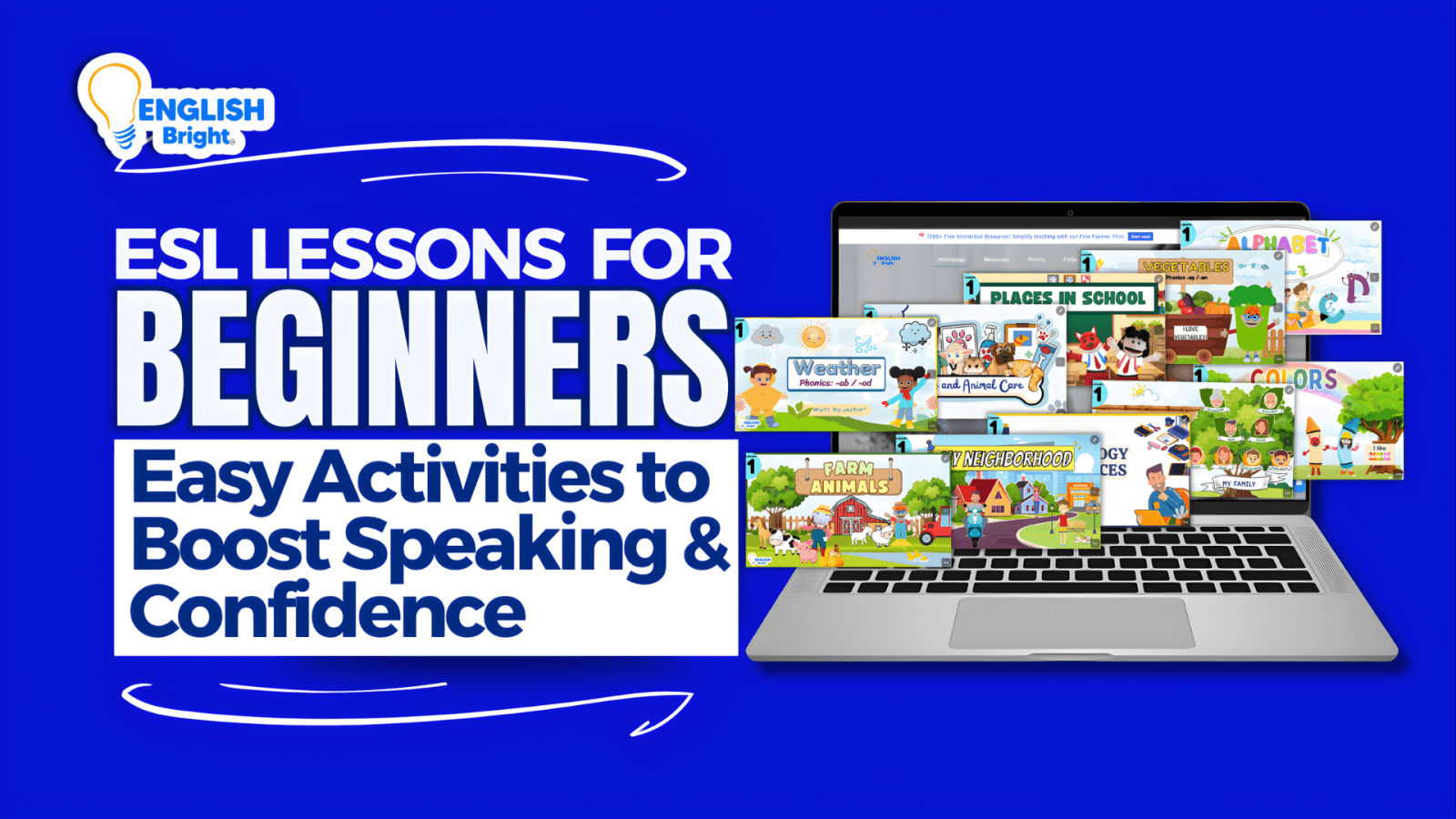
Building speaking confidence in new English learners requires more than just vocabulary lists and grammar drills. True learning happens when beginners interact, repeat meaningful sentences, and engage in enjoyable activities that encourage them to use the language naturally. This is why ESL lessons for beginners must be simple, structured, and highly interactive.
At English Bright, our Level 1 curriculum for beginners includes 12 carefully designed units that build foundational vocabulary, pronunciation, and sentence patterns—step-by-step. Each lesson encourages speaking from the very first minute. Below, you’ll discover practical strategies, fun activities, and an actual lesson example that you can use immediately in your ESL class.
Why ESL Lessons for Beginners Need Structure and Repetition
Teaching new English learners requires predictable routines. Beginners learn best when lessons include:

- Clear vocabulary
- Short, repeatable sentences
- Visual and auditory cues
- Movement and sounds
- Confidence-building speaking practice
Structured lessons limit confusion and help learners focus on speaking without feeling overwhelmed. This is especially important for kids and absolute beginners who may rely heavily on modeling and repetition.
English Bright’s 12-unit Level 1 curriculum follows this approach, blending speaking, phonics, motor exercises, and simple grammar to help learners progress naturally.
Core Elements of Effective ESL Lessons for Beginners
To ensure beginners understand and speak confidently, every ESL lesson should include these elements:
1. Vocabulary Input with Visual Support
Beginners need pictures, gestures, and real objects. Introducing words with TPR (Total Physical Response) or flashcards helps the brain create strong associations.
2. Simple and Repetitive Sentence Patterns
Instead of giving multiple complex structures, one or two clear sentences per lesson are enough.
Example:
- “I ride a bus.”
- “I ride a van.”
Learners build fluency through repetition.
3. Pronunciation and Oral Motor Exercises
Beginners benefit from exaggerated mouth movements, sound drills, and fun noises that develop clarity.
Example: “beep beep beep” or “honk honk honk” for vehicle lessons.
4. Guided Speaking Practice
Learners repeat after the teacher, read aloud, and practice in pairs. Speaking must happen throughout the lesson—not just at the end.
5. Fun Activities to Apply Learning
Games and interactive tasks allow beginners to use language in context, making the lesson memorable and enjoyable.
These elements appear consistently in English Bright’s Level 0 units, ensuring that each lesson builds confidence and prepares learners for Level 1.
Easy Activities for ESL Beginners to Boost Speaking and Confidence
Below are beginner-friendly activities you can use in any ESL lesson. These strategies fit both online and classroom environments and work especially well for Level 0 learners.
1. Repeat-After-Me Drills
Repetition builds confidence. Say the sentence slowly, clearly, and with emotion. Encourage students to echo the sentence with matching energy.
Example:
Teacher: “I ride a bus.”
Students: “I ride a bus!”
This supports:
- Memory
- Pronunciation
- Sentence fluency
2. Picture Identification
Hold up images or flashcards and ask:
- “What is it?”
- “Bus!”
Then guide them into the full sentence: - “I ride a bus.”
This activity makes vocabulary meaningful and interactive.
3. Sound Imitation (Oral Motor Training)
Especially useful for young learners, sound play helps shape mouth movements needed for real words.
Examples:
- “Beep beep beep”
- “Honk honk honk”
- “Vvvv-vvvv-van!”
This makes pronunciation practice fun and natural.
4. Counting with Actions
Numbers become easier when combined with movement.
Example:
- Clap while counting up to 22 or 23
- Tap the desk for each number
- Use fingers, hops, or jumps
This helps beginners develop rhythm, memory, and number fluency.
5. Role-Play with Props
Toy vehicles, puppets, or classroom objects can turn a simple ESL lesson into a speaking adventure.
Example:
Hold a toy bus.
Ask: “What do you ride?”
Student: “I ride a bus!”
Props stimulate imagination and lower anxiety.
6. Match and Say
Place vehicle or object cards on the table. Students choose a card and form a sentence.
Example:
Student picks the van card → “I ride a van.”
Simple games like matching keep students active and speaking.
7. Mini Conversations
Beginners benefit from short dialogues.
Example:
A: “What do you ride?”
B: “I ride a bus!”
Even short exchanges build real communication skills.
8. Teacher-Led Songs and Chants
Songs boost memory and reduce speaking fear. A simple chant like:
“Bus, bus, bus—beep beep beep!”
can transform vocabulary into an enjoyable learning experience.
Sample Lesson from English Bright: Level 1 Unit 6 – Farm Animals (Lesson 1)
To help teachers visualize what an effective beginner-friendly animal lesson looks like, here’s an example from our Farm Animals unit focusing on three essential vocabulary words: cow, sheep, and duck.
Lesson Focus: Cow, Sheep, Duck
Vocabulary
- cow
- sheep
- duck
Sentence Patterns
Students practice key question-and-answer patterns such as:
- “What farm animal is big?”
- “A cow is big.”
- “What farm animal is small?”
- “A duck is small.”
Learners repeat these patterns until they can respond naturally and confidently.
Sight Words
Students will recognize and read the following sight words:
- jump
- help
- two
- you
Grammar Focus
The lesson introduces the affirmative and negative forms of the verb “to be”:
- I am
- I am not
Students practice using these forms correctly in simple sentences.
Phonics Practice
Phonics activities focus on the ‘as’ sound
(as in a + s = “as”).
Students practice identifying, pronouncing, and using this sound in short words.
Concept Development: Size Comparison
Learners explore size concepts:
- small
- smaller
- smallest
They compare farm animals to build both vocabulary and critical thinking skills.
Activity Integration
Teachers guide students through:
- Vocabulary review
- Picture identification
- Repeat-after-me drills
- Speaking practice with animal images
- Size comparison tasks
- Phonics identification
- Short Q&A practice
By the end of the lesson, students confidently use the vocabulary, sentence patterns, and grammar structures introduced.
The structure, simplicity, and interactive activities make this farm animal lesson highly effective for beginners.
How to Build Confidence in Every Beginner ESL Lesson
Beginners need more than comprehension—they need emotional support. Anxiety is one of the biggest barriers to speaking, so teachers must create a safe, encouraging environment.
Here’s how:
1. Praise Often
Simple phrases work wonders:
- “Great job!”
- “Yes! You can do it!”
- “Try again—you’re getting better!”
2. Use Predictable Routines
Routines like vocabulary → sentence → activity → speaking help beginners know what to expect.
3. Keep Instructions Short
Beginners understand better when teachers model instead of explain.
4. Maintain High Energy
Your energy fuels their confidence.
5. Let Students Succeed Early
Start with easy wins to build momentum.
Teaching Tips for Your ESL Lessons for Beginners
✔ Tip 1: Use Big Gestures and Expressions
Beginners rely on visual cues. Overact your facial expressions and gestures to help them understand new words quickly.
✔ Tip 2: Don’t Overload Vocabulary
2–4 new words per lesson is ideal. Too many causes confusion and reduces speaking.
✔ Tip 3: Encourage Full-Sentence Answers
Instead of just “bus,” guide students to say, “I ride a bus.”
✔ Tip 4: Incorporate Movement
Clapping, jumping, tapping, or pointing keeps beginners engaged and improves memory.
✔ Tip 5: Repeat in Different Ways
Use chants, whispers, fast/slow repetition, and echo drills to keep practice fun.
✔ Tip 6: Celebrate Every Attempt
Even if pronunciation isn’t perfect, praise the effort. Confidence leads to fluency.
✔ Tip 7: Use Consistent Visuals
Flashcards, images, and classroom objects are powerful tools for beginners.
Why English Bright’s Level 1 is Perfect for ESL Beginners
Many teachers struggle to create structured lessons for absolute beginners. English Bright solves this by offering:
🔥 12 carefully designed units
covering vocabulary, speaking patterns, reading readiness, numbers, phonics, and oral motor training.
🔥 Step-by-step sentence building
so students develop fluency naturally.
🔥 Activities that build confidence
through repetition, games, and guided speaking.
🔥 Ready-to-use lessons
ideal for new teachers, busy teachers, and online ESL instructors.
Each Level 1 lesson—like the Farm Animals example—includes speaking practice, motor exercises, and interactive activities, making it perfect for beginners who need a gentle, confidence-building start.
Teaching ESL lessons for beginners is both rewarding and exciting. With simple activities, consistent routines, and structured lessons like English Bright’s Level 0 units, teachers can help students speak confidently from the very first class.
Beginners don’t need complicated grammar—they need repetition, fun, and encouragement. When students feel safe, supported, and engaged, their confidence grows, and their speaking skills flourish.
If you want ready-made lessons that follow this approach, English Bright’s Level 1 curriculum gives you everything you need to build a strong ESL foundation—one simple, meaningful lesson at a time.

Leave a Reply