

If you are teaching English regularly, you already know the truth: planning takes more time than teaching.
Between trial lessons, regular classes, parent communication, and progress tracking, most teachers spend hours preparing for a single session. That’s why strong, structured ESL lesson plans are no longer optional, they are essential.
In 2026, teaching English is faster paced, more competitive, and more digital than ever. Whether you teach online, in a learning center, or in a traditional classroom, having a repeatable lesson plan ESL structure can save you hours every week while improving student results.
This guide will show you:
- What makes effective ESL lesson plans
- A simple, repeatable framework you can use immediately
- How to adapt plans for online and in-person teaching
- Why structured lessons increase student confidence
- How to organize all ESL lessons organized and ready to teach
Let’s begin.
Why ESL Lesson Plans Matter More Than Ever
Teaching without a plan leads to:
- Overthinking before class
- Awkward transitions
- Uneven pacing
- Students feeling confused
- Parents questioning structure
Strong ESL lesson plans solve these problems by creating:
- Clear learning objectives
- Predictable lesson flow
- Logical skill progression
- Measurable outcomes
When students know what to expect, they relax. When teachers know what comes next, they teach with confidence.
Using the same structure each lesson builds student confidence and smoother classes. Instead of wondering “What are we doing next?”, students focus on learning.
The 5-Part ESL Lesson Plan Framework (That Works in 2026)
Busy teachers need a system not random activities.

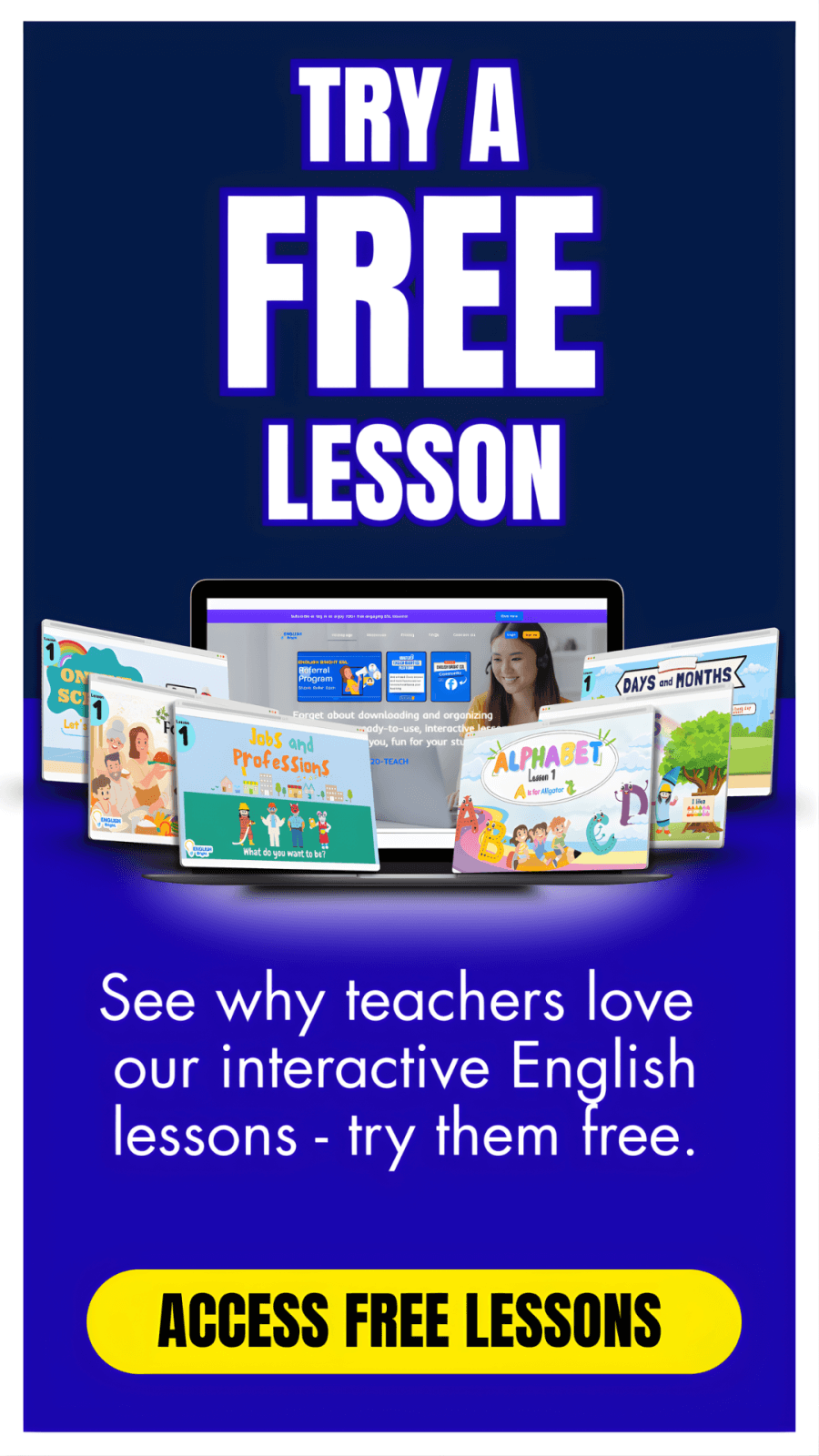
(Click the image to view the lesson)
Here’s a proven structure you can use for almost any age group.
1. Warm-Up (5–7 Minutes)
Purpose: Activate prior knowledge and build energy.
Examples:
- Quick review questions
- Picture prompts
- Simple conversation starter
- Vocabulary flash review
This part should be predictable. Students feel secure when lessons start the same way every time.
2. Presentation (10 Minutes)
Purpose: Introduce new language clearly and simply.
Focus on:
- Target vocabulary
- Sentence patterns
- Pronunciation modeling
- Contextual examples
Keep instructions clear. Avoid overwhelming students with too much input at once.
A good lesson plan ESL design introduces one main structure per lesson.
3. Guided Practice (10–15 Minutes)
Purpose: Controlled practice with teacher support.
Examples:
- Fill-in-the-blank speaking drills
- Matching activities
- Drag-and-drop exercises (for online teachers)
- Structured pair work
This stage is where repetition happens. Repetition builds retention.
4. Production (10 Minutes)
Purpose: Independent use of the target language.
Examples:
- Role-play
- Mini presentation
- Guided conversation
- Short written response
This is where students gain real confidence. They apply what they learned without heavy prompting.
5. Review & Homework (5 Minutes)
Purpose:
- Reinforce key learning points
- Preview next lesson
- Assign simple follow-up
When homework connects directly to class structure, students feel continuity.
How to Adapt ESL Lesson Plans for Online Teaching
Online ESL teachers face unique challenges:
- Shorter attention spans
- Screen fatigue
- Technical distractions
- Limited physical movement
Your ESL lesson plans must be more visual and interactive.
Tips for online adaptation:
- Use slides with clear structure
- Include interactive elements (clicking, choosing, dragging)
- Break instructions into smaller steps
- Build in frequent student speaking time
Online lessons require rhythm. Every 3–5 minutes, something should change a question, a visual, a task.
Structured digital lessons prevent awkward silence and technical confusion.
How to Adapt Lesson Plan ESL Structures for Classroom Settings
In-person classes allow more movement and group interaction.
Adjust your framework by:
- Adding pair rotations
- Incorporating physical response activities
- Using board writing strategically
- Including short team competitions
However, the core structure should remain the same.
Warm-up → Presentation → Practice → Production → Review
Consistency is key.

(Click the image to view the lesson)
The Power of Repeatable Structure
Many teachers believe creativity means doing something different every lesson.
In reality, students thrive on structure.
When your ESL lesson plans follow a repeatable system:
- Students understand transitions
- Classroom management improves
- Parents see progress
- Teaching becomes less stressful
Think of a structure like scaffolding. Once built, learning becomes smoother.
A consistent lesson plan ESL format allows you to focus on delivery rather than planning from scratch every time.
Organizing All ESL Lessons Organized and Ready to Teach
The biggest time-saver in 2026 is organization.
Instead of searching through random files, imagine having:
- Lessons grouped by level
- Units organized by theme
- Clear objectives listed
- Homework aligned with lessons
- Speaking tasks integrated
- Review built into each unit
All ESL lessons organized and ready to teach means:
You open the lesson.
You teach.
You close your laptop.
You move on with your day.
No scrambling. No last-minute searching.
Professional teachers rely on systems not scattered resources.
Common Mistakes in ESL Lesson Planning
Even experienced teachers make these errors.
1. Too Many Objectives
One lesson should focus on one main structure.
Example:
Instead of teaching past tense + time expressions + question formation all together, choose one focus.
2. Talking Too Much
Presentation should not dominate the lesson.
Students learn by speaking, not listening.
3. No Clear Outcome
Every lesson should answer:
What can the student do by the end?
Examples:
- Use “I like…” sentences
- Ask and answer about family
- Describe daily routines
4. No Built-In Review
Without repetition across lessons, retention drops.
Strong ESL lesson plans include ongoing review naturally within the structure.
ESL Lesson Plans for Different Age Groups
Young Learners (Ages 4–8)
- Shorter segments
- Visual-heavy materials
- Repetition through games
- Clear gestures and modeling
Structure must be simple and consistent.
Pre-Teens (9–12)
- More guided discussion
- Real-life topic integration
- Controlled grammar focus
- Confidence-building speaking tasks
Teens
- Opinion-based production
- Debate-style discussions
- Scenario role-play
- Gradual grammar expansion
The framework remains the same only the task complexity changes.
Trial Lessons: Why Structure Wins
Trial classes can determine whether a student enrolls.
Without structured ESL lesson plans, trial lessons feel improvised.
With structure:
- Parents see organization
- Students feel guided
- Teachers appear confident
When lessons follow a clear, repeatable flow, families feel secure signing up long-term.
Professional structure builds trust.
Building a Sustainable Teaching System in 2026
Burnout is real.
Teachers who create new plans every single day eventually feel overwhelmed.
Instead, build a system:
- Create a repeatable framework
- Use organized units
- Track student progress
- Adjust pacing when needed
- Keep lessons aligned by level
A reliable lesson plan ESL system turns teaching into a professional operation not a daily improvisation.
What Modern ESL Lesson Plans Should Include in 2026
Teaching is evolving. Effective ESL lesson plans today include:
- Clear learning goals
- Speaking-focused practice
- Digital adaptability
- Homework alignment
- Built-in review
- Structured repetition
The best systems ensure that all ESL lessons organized and ready to teach are accessible by level and objective.
Teachers shouldn’t have to redesign the structure each time.

Top 5 Companies That Offer ESL Lesson Plans
If you’re looking for structured ESL lesson plans to support your teaching, here are five well-known providers teachers often explore in 2026:
1. Twinkl ESL
Twinkl ESL provides a wide variety of classroom-based English teaching materials, including themed lesson plans, worksheets, and activity packs for different age groups.
2. English Bright ESL
English Bright ESL offers structured, interactive ESL lesson plans designed for teachers who teach regularly. Lessons are organized by level and unit, with a consistent framework that helps create smoother classes and stronger student confidence.
3. ESL Brains
ESL Brains offers high-quality, conversation-based lesson plans designed for teens and adults, with a strong focus on real-world topics and speaking practice. Their lessons are especially useful for teachers who want ready-to-use materials that encourage meaningful discussion and critical thinking in the classroom. Many online teachers use ESL Brains alongside structured platforms to balance engaging conversation with clear lesson flow.
4. Off2Class
Off2Class provides digital lesson plans and assessment tools that allow teachers to track student progress. Their platform includes structured units with built-in activities and quizzes.
5. British Council
The British Council offers English teaching resources, lesson plans, and structured activities for classroom and online educators worldwide.

Final Thoughts: From Busy to Balanced
Busy teachers don’t need more random ideas.
They need:
- Clear structure
- Organized materials
- Repeatable frameworks
- Confidence in delivery
Strong ESL lesson plans create smoother classes, happier students, and more predictable results.
When your lesson plan ESL structure is consistent, teaching becomes easier and more professional.
In 2026, the teachers who thrive are not the ones who work the longest hours.
They are the ones who use systems.
If you want less stress, stronger student results, and more confident teaching, start with structure.
Because when all ESL lessons organized and ready to teach are built into your system, you don’t just save time.
You build a sustainable teaching career.

Leave a Reply