
Teaching the alphabet to ESL students might seem straightforward—introduce the letters, have students repeat them, and drill until they stick, right?
Not quite.
The real secret to teaching the ESL alphabet isn’t memorization alone. It’s about making letters meaningful, interactive, and connected to real-world language use. When letters are taught in context—through words, sentences, sounds, and movement—students learn faster and retain more.
If your students struggle to remember letters or lose interest quickly, it’s time to rethink your approach. Here’s what many ESL teachers overlook—and how you can fix it.
Teaching the ESL Alphabet in Context
One common mistake is teaching letters in isolation, moving from A to Z without linking them to meaningful language. For beginner ESL learners, letters alone don’t carry much value.
Instead, letters should be taught alongside words, sounds, grammar, and simple communication.
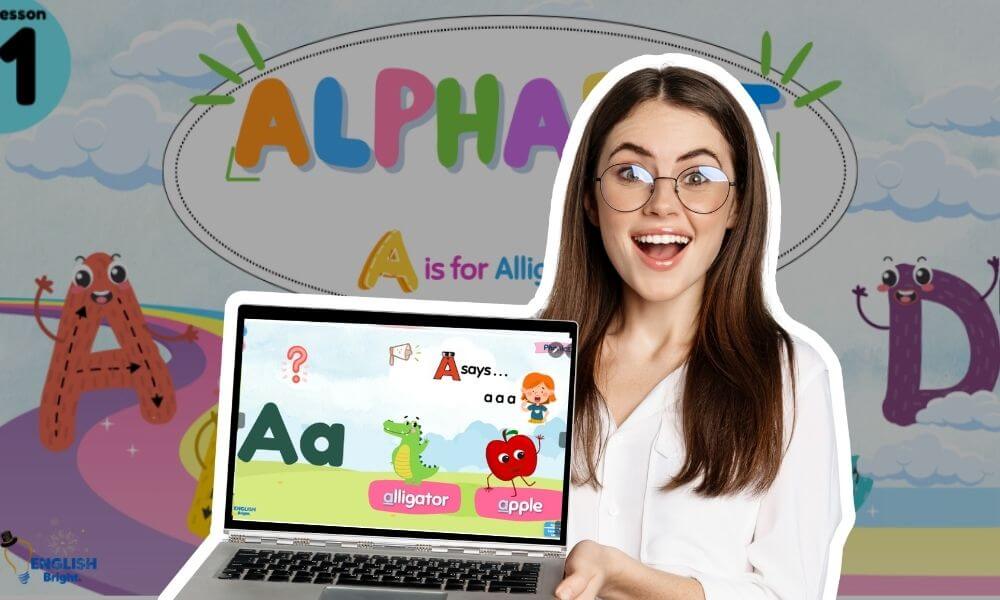
Check this lesson: Level 1 Unit 1: Alphabet

Example: Teaching A and B in an ESL Alphabet Lesson
In a beginner ESL alphabet lesson, students learn:
- Letter A for alligator
- Letter B for banana
Rather than focusing only on letter names, students practice:
- Phonics sounds: /a/ and /b/
- Vocabulary connected to real objects
- Sentence patterns like “I am a girl” and “I am a boy”
- Sight words such as “a,” “I,” and “am”
By combining letters with meaningful language, students understand how the ESL alphabet functions in real communication—not just on flashcards.
Effective Strategies for Teaching the ESL Alphabet
Here are proven strategies that make ESL alphabet lessons more effective:
- Teach letters using familiar words and visuals. Let students see, touch, and say the word together.
- Encourage students to say the letter and word together:
“A, A, alligator!” or “B, B, banana!” - Use a phonics-based approach, focusing on letter sounds instead of letter names first.
- Start with high-frequency letters (like A, B, S, M, T, P) instead of strictly following A–Z order.
These strategies help students connect sounds, meaning, and usage—key to ESL alphabet mastery.
Why Teaching the ESL Alphabet in Context Works
When learners associate a letter with a word, sound, and sentence, they remember it more quickly and use it more naturally.
For example, practicing plural nouns alongside alphabet learning allows students to recognize patterns early:
- one banana → two bananas
This integrated approach strengthens vocabulary, grammar, and phonics all at once, supporting overall language development.
Using Movement and Hands-On Activities for ESL Alphabet Learning
Writing letters on the board isn’t enough for young or beginner learners. The ESL alphabet becomes memorable when students move, touch, and interact.
Interactive ESL Alphabet Activities
- Letter scavenger hunt – Students find letter cards and name a word that starts with the letter.
- Alphabet yoga – Students form letters with their bodies.
- Sensory writing – Tracing letters in sand, paint, or shaving cream reinforces muscle memory.
These activities engage multiple senses, helping students process the ESL alphabet more deeply.
Turning ESL Alphabet Learning into a Game
Alphabet drills can feel repetitive—for teachers and students. Turning lessons into games increases motivation and attention.
Fun Games for Teaching the ESL Alphabet
- Alphabet Bingo – Students listen, say the letter aloud, and mark it.
- Alphabet songs and chants – Music helps letters stick.
- Letter Jump – Students jump to floor letters while saying the letter name or sound.
Play-based learning lowers anxiety and makes ESL alphabet lessons feel fun rather than forced.
Teaching Uppercase and Lowercase Letters Effectively
Introducing uppercase and lowercase letters at the same time can overwhelm beginners. A better approach is to start with uppercase letters, then gradually introduce lowercase through reading and real-world exposure.
Best Practices for ESL Alphabet Letter Cases
- Teach uppercase letters first with games and visuals.
- Introduce lowercase letters using books, labels, and classroom signs.
- Use matching activities to connect uppercase and lowercase letters.
This method aligns with how students naturally encounter letters in their environment.
Strengthening ESL Alphabet Lessons with Cross-Skill Learning
A strong ESL alphabet lesson doesn’t stop at letters. Integrating basic math, such as simple single-digit addition, reinforces thinking skills and keeps lessons engaging.
By combining:
- Alphabet learning
- Phonics practice
- Sight words
- Grammar basics
- Simple math
students build confidence across multiple skill areas in one cohesive lesson.

Leave a Reply