
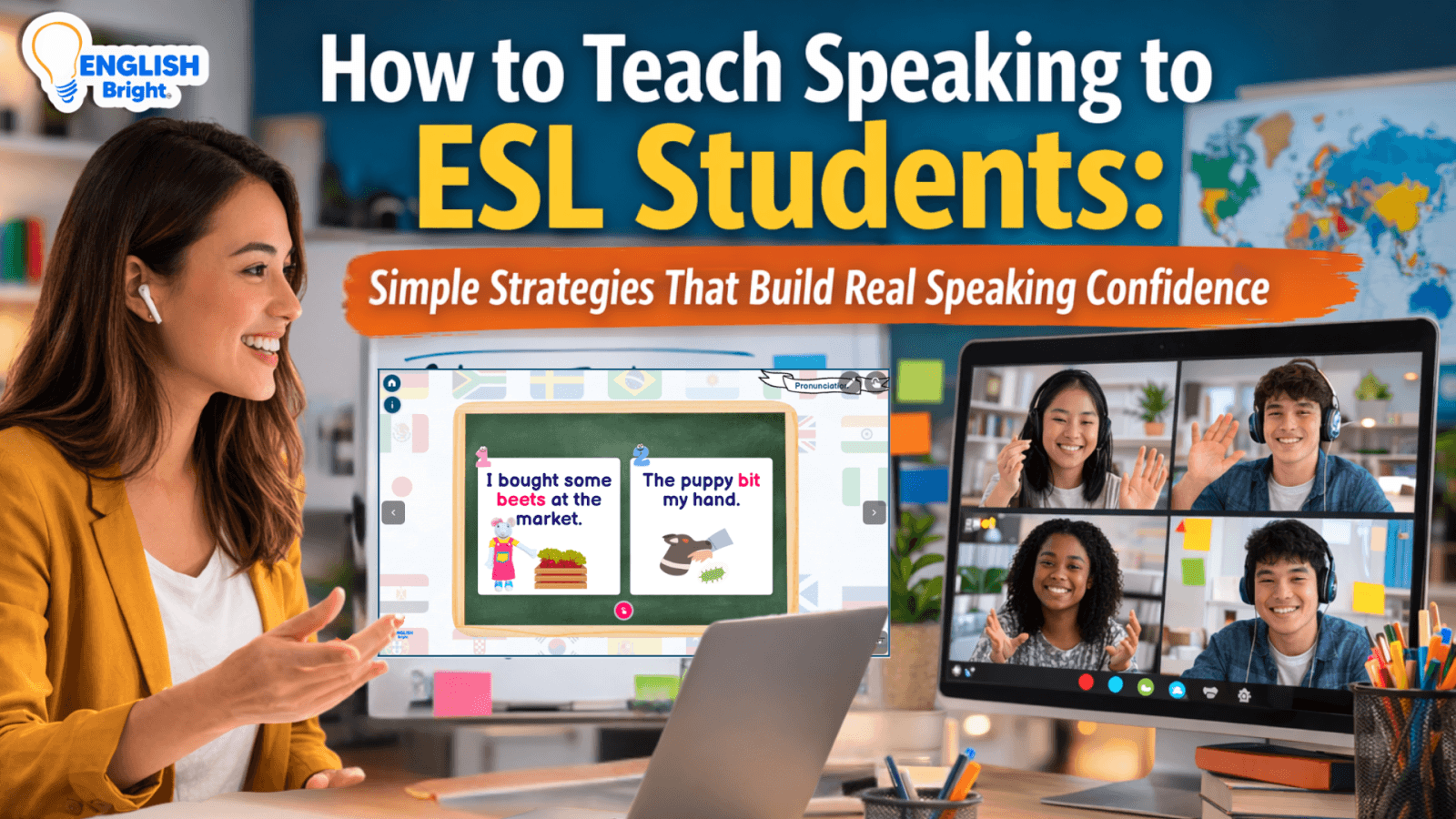
Teaching speaking is one of the most important goals in English language learning. Many students study English for years, yet they still feel nervous when it is time to speak. For ESL teachers, the challenge is finding ways to turn vocabulary and grammar into real communication.
Understanding how to teach speaking to ESL students effectively can make a huge difference in the classroom. When lessons focus on practical speaking opportunities, students begin to use English naturally and confidently.
In this article, we will explore simple strategies that help ESL students develop real speaking skills, while also showing how structured lessons can guide students step-by-step toward fluency.

Why Speaking Skills Are Important for ESL Students
For many learners, speaking is the main reason they study English. They want to communicate with teachers, classmates, coworkers, or people around the world.
However, speaking can also be the most difficult skill to develop. Students often struggle with:
- Limited vocabulary
- Fear of making mistakes
- Difficulty with pronunciation
- Lack of opportunities to practice speaking
Because of these challenges, teachers need effective methods when learning how to teach ESL students to speak English. The goal is not only to teach words but to help students use those words in meaningful conversations.
Start with Vocabulary That Supports Speaking
One of the first steps in learning how to teach speaking skills to ESL students is introducing vocabulary that students can use in real situations.
Instead of teaching random words, teachers should focus on topic-based vocabulary that connects to speaking activities.
For example, in a lesson about culture and traditions, students may learn words such as:
- culture
- tradition
- ethnic group
- Spring Festival
These words give students a clear theme to talk about. Once students understand the vocabulary, teachers can guide them to discuss questions such as:
- What traditions do people celebrate in your country?
- What food do people eat during festivals?
- Do you celebrate the Spring Festival?
Topic-based vocabulary encourages students to express ideas instead of simply memorizing words.
Connect Vocabulary to Sentence Patterns
Vocabulary alone does not help students speak confidently. Students also need simple sentence patterns that guide their answers.
When teachers are exploring how to teach speaking to ESL students, it is helpful to provide clear sentence structures that students can practice repeatedly.
For example:
- “This tradition is important in my culture.”
- “People celebrate the Spring Festival with family.”
- “My favorite tradition is…”
These patterns give students a framework for building longer responses.
Over time, students learn to expand their answers naturally:
- “My favorite tradition is the Spring Festival because my family eats together and watches fireworks.”
Providing structured sentence patterns helps students move from single words to full conversations.
Use Pronunciation Practice to Improve Speaking Confidence
Pronunciation is a major factor when learning how to teach ESL students to speak English. If students feel unsure about pronunciation, they may avoid speaking altogether.
A good speaking lesson should include focused pronunciation practice.
For example, students can practice differentiating between short and long vowel sounds, such as:
- /ɪ/ as in sit
- /iː/ as in seat
These sounds often cause confusion for English learners.
Teachers can guide students through activities like:
- Listening and repeating word pairs
- Identifying correct pronunciation in sentences
- Practicing minimal pairs aloud
When students learn to recognize and pronounce these sounds correctly, their speaking becomes clearer and more confident.

Encourage Guided Speaking Practice
Another key strategy when learning how to teach speaking skills to ESL students is guided speaking practice.
Instead of asking students to speak freely immediately, teachers can provide structured questions.
Examples include:
- “What culture do you belong to?”
- “What traditions do you celebrate?”
- “What festivals are important in your country?”
Students can answer using previously learned vocabulary and sentence patterns.
Guided speaking activities help students practice communication while still receiving support from the teacher.
Create Opportunities for Discussion
Speaking improves when students are given chances to share opinions and personal experiences.
Teachers can encourage discussion through activities such as:
Pair Conversations
Students talk with a partner about cultural traditions in their country.
Small Group Discussions
Students compare different festivals from around the world.
Question and Answer Activities
Teachers ask questions and students respond using complete sentences.
These activities help students develop real communication skills, which is the ultimate goal when learning how to teach ESL students to speak English.
Use Structured ESL Lessons
One reason speaking lessons sometimes fail is that they lack clear organization. Teachers may jump from vocabulary to speaking without enough practice or structure.
Structured ESL lessons help solve this problem.
For example, English Bright ESL lessons follow a consistent format that supports speaking development.
In one lesson, students explore the topic of different cultures and traditions by examining vocabulary related to:
- culture
- tradition
- ethnic group
- Spring Festival
Students then focus on pronunciation by practicing the short vowel /ɪ/ and long vowel /iː/ sounds. These pronunciation exercises help students differentiate between words that sound similar but have different meanings and spellings.
After pronunciation practice, students apply what they learned through guided speaking questions and discussion activities.
This structured approach helps students gradually build speaking confidence step by step.
Focus on Communication, Not Perfection
One of the biggest mistakes teachers make when learning how to teach speaking to ESL students is correcting every small mistake.
While correction is important, too much correction can make students feel nervous about speaking.
Instead, teachers should focus on communication first.
If students successfully express an idea, the teacher can later guide them toward improving grammar or pronunciation.
Encouraging communication helps students feel comfortable speaking English without fear.
Provide Repetition and Practice
Speaking confidence develops through repeated practice.
Students need multiple opportunities to:
- hear vocabulary
- practice pronunciation
- answer questions
- participate in discussions
When teachers revisit the same vocabulary and sentence patterns across different activities, students gradually become more fluent.
This repetition is a key element when mastering how to teach speaking skills to ESL students.

Use Real-Life Topics That Students Understand
Speaking activities are more effective when students can relate to the topic.
Cultural traditions, family celebrations, and festivals are excellent discussion topics because students already have experiences to share.
For example, students may talk about:
- family traditions
- national holidays
- seasonal celebrations
- traditional food
When students discuss familiar topics, they naturally produce longer and more meaningful responses.
Build Confidence Step by Step
Confidence is the foundation of speaking ability.
Teachers can help students build confidence by following a gradual learning process:
- Introduce vocabulary
- Practice pronunciation
- Provide sentence patterns
- Ask guided questions
- Encourage open discussion
This step-by-step approach helps students feel prepared before speaking.
As a result, students begin to participate more actively in class conversations.
How Structured Lessons Support Speaking Development
Many ESL teachers spend hours preparing speaking activities. However, well-designed curriculum materials can save time while improving lesson quality.
Structured ESL programs provide:
- clear vocabulary progression
- pronunciation practice
- guided speaking questions
- interactive activities
For example, English Bright ESL lessons integrate vocabulary, pronunciation, and discussion activities within a single lesson structure. This allows teachers to focus on guiding conversations instead of building lessons from scratch.
When lessons follow a consistent structure, students also feel more comfortable participating in speaking activities.
Final Thoughts
Learning how to teach speaking to ESL students requires more than simply asking students to talk. Effective speaking lessons combine vocabulary, pronunciation practice, sentence patterns, and guided discussions.
When teachers use clear lesson structures and meaningful topics, students begin to speak more naturally and confidently.
By focusing on communication, encouraging discussion, and providing repeated speaking practice, teachers can help ESL learners turn classroom knowledge into real-life conversation skills.
Over time, these strategies help students develop the confidence they need to speak English clearly, comfortably, and successfully.


Leave a Reply