
Teaching vocabulary is one of the biggest challenges in ESL classrooms. Using flashcards for ESL learners is an effective way to reinforce new vocabulary and help words stick in students’ memories. Students may learn new words during a lesson, but many teachers notice that those same words are forgotten quickly after class ends. Without consistent exposure and meaningful practice, vocabulary can fade from memory.
This is why Flashcards for ESL remain one of the most powerful teaching tools for language teachers. Flashcards provide visual support, repetition, and structured vocabulary practice that helps students remember words longer and use them with confidence.
When used correctly, flashcards do much more than introduce vocabulary. They help students connect images to meaning, practice pronunciation, and gradually turn new words into real communication.
In this article, we will explore why Flashcards for ESL are so effective, how teachers can use them to strengthen vocabulary retention, and how structured flashcard systems such as those used in English Bright ESL lessons help students build long-term language skills.
Why Vocabulary Is Easy to Forget for ESL Students
Many ESL teachers experience the same situation in class. Students recognize vocabulary during the lesson, but when the next class begins, the words are no longer fresh in their minds.
There are several reasons why this happens:
- Limited exposure to the vocabulary outside the classroom
- Lack of visual memory support
- Minimal repetition after the first lesson
- Few opportunities to use the words in conversation
Young learners and beginners especially rely on visual connections when learning new language. When vocabulary is introduced through text alone, students may struggle to remember it.
This is where vocabulary flashcards for ESL students become extremely valuable. By combining images, text, and pronunciation practice, flashcards create multiple memory connections that help students remember words long after the lesson ends.
Why Flashcards for ESL Work So Well
Flashcards are effective because they combine several learning strategies in one simple tool.
Visual Memory
Students remember pictures more easily than isolated text. When learners see an image connected to a word, their brain creates a stronger memory link.
For example, a flashcard showing a picture of a mother with the word printed clearly underneath helps students associate the visual image with the vocabulary.
Repetition Without Boredom
Flashcards allow teachers to repeat vocabulary many times in different ways. Teachers can show the card, ask questions, play games, or use the card for sentence practice.
This repetition strengthens vocabulary retention while keeping the class interactive.
Speaking Opportunities
Flashcards naturally encourage speaking practice. Teachers can ask simple questions such as:
- “What is this?”
- “Who is she?”
- “Is this your mother or your sister?”
Students respond using the vocabulary from the flashcards, turning passive recognition into active language use.
Flashcards for ESL Beginners
For beginners, vocabulary learning must be simple, visual, and repetitive. This is why flashcards for ESL beginners are one of the most recommended teaching resources.
Beginner students benefit from flashcards because they:
- Introduce vocabulary in a clear and visual way
- Provide simple pronunciation practice
- Help students connect pictures with meaning
- Encourage short speaking responses
For example, a beginner lesson may include flashcards for:
- cat
- dog
- bird
- fish
The teacher shows each card, models the pronunciation, and asks the class to repeat the word. Then the teacher asks simple questions like:
“What animal is this?”
Students answer:
“It is a cat.”
Over time, this simple pattern helps students build both vocabulary and sentence confidence.
Turning Flashcards into Speaking Practice
One of the most powerful ways to use Flashcards for ESL is by turning them into guided speaking activities.
Instead of only asking students to identify the picture, teachers can expand the activity with simple sentence patterns.
For example:
Teacher shows a flashcard of a dog.
Teacher asks:
“What animal is this?”
Student answers:
“It is a dog.”
The teacher can extend the conversation:
“Do you like dogs?”
Student answers:
“Yes, I do.”
These small speaking patterns help students transform vocabulary into real communication.
How Structured Flashcards Improve Vocabulary Retention
While flashcards are useful on their own, they become even more powerful when they are organized into a structured curriculum.
In English Bright ESL, flashcards are designed to align with each lesson so that vocabulary is introduced at the right time and reinforced through activities.
English Bright provides Flashcards for ESL from Level 0 to Level 5, ensuring that teachers have visual vocabulary support for every stage of learning.
Each level introduces vocabulary appropriate for the student’s age and language ability, helping teachers build language skills step by step.
Because the flashcards connect directly to the lesson topic, students repeatedly encounter the same vocabulary in multiple contexts.
Example English Bright Flashcards Lesson
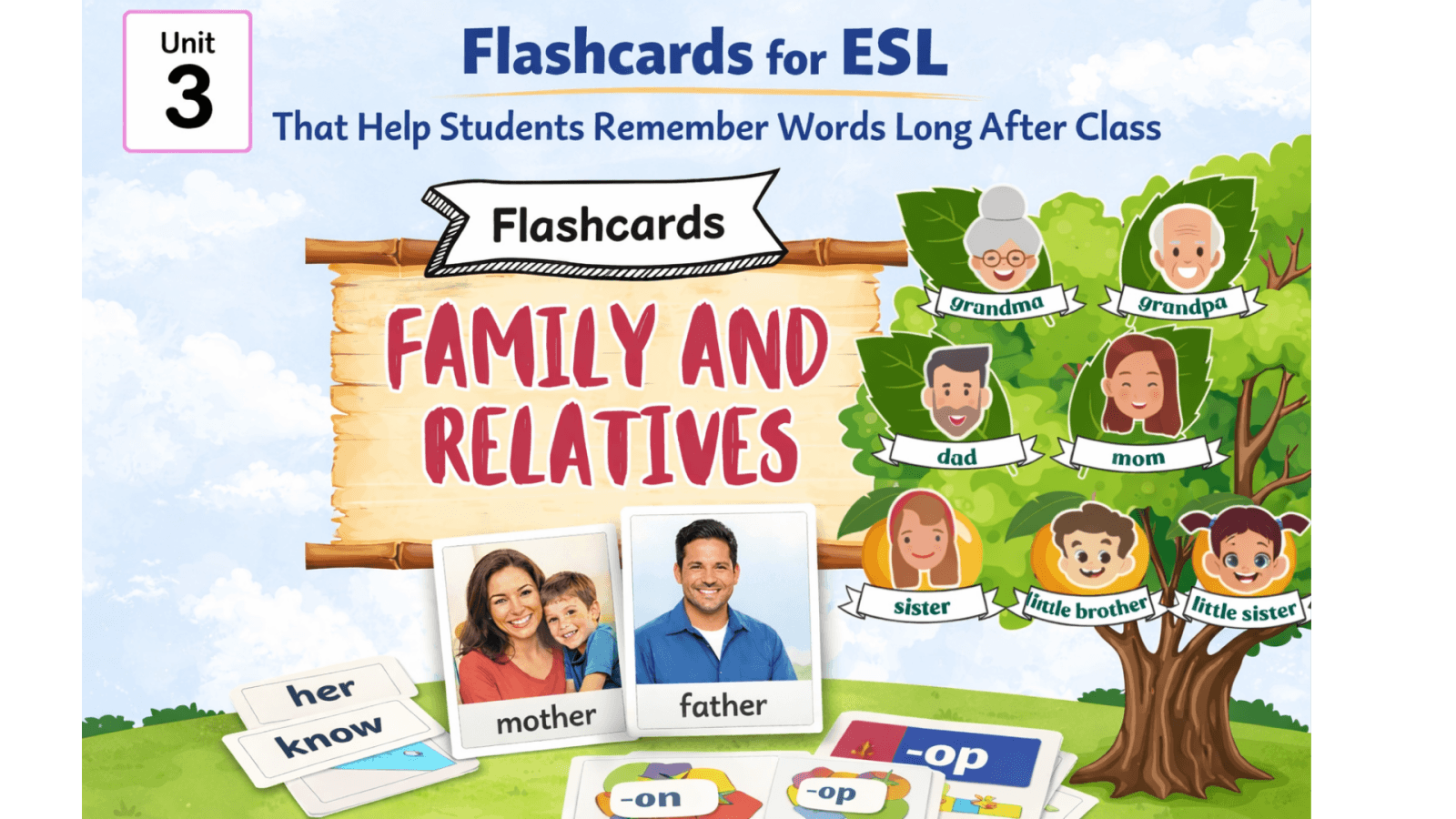
One example comes from Level 2 Unit 3: Family and Relatives.

This flashcard set introduces important family vocabulary such as:

- family
- mother
- father
- parents
- siblings
Each flashcard is designed with several learning features:
Bold vocabulary text
Students can clearly see the word associated with the image.
Colorful illustrations
Visual images help students quickly understand the meaning of the word.
Phonics sounds
The cards include phonics patterns such as -on and -op, which help students develop reading and pronunciation skills.
Sight words practice
Sight words such as her, his, could, and know are incorporated into the flashcards to strengthen reading fluency.
By combining vocabulary, phonics, and sight words in one activity, these flashcards reinforce multiple language skills at the same time.
For students, learning about family becomes both educational and enjoyable, while teachers gain a structured tool that supports the lesson objectives.
Classroom Activities Using Flashcards for ESL
Teachers can use flashcards in many creative ways during lessons. Here are several simple activities that help students practice vocabulary effectively.
Quick Vocabulary Review
At the beginning of class, the teacher quickly reviews vocabulary by showing flashcards and asking students to identify the words.
This activity refreshes vocabulary from previous lessons and strengthens memory.
Guess the Word
The teacher slowly reveals part of the flashcard image and asks students to guess the word.
Students become curious and engaged while practicing vocabulary recall.
Question and Answer Practice
Flashcards are perfect for guided speaking practice.
Example:
Teacher shows a flashcard of mother.
Teacher asks:
“Who is she?”
Student answers:
“She is my mother.”
This simple activity helps students practice both vocabulary and sentence patterns.
Flashcard Memory Game
Teachers can place flashcards face down and allow students to turn them over one at a time.
When students reveal a card, they must say the vocabulary word or use it in a sentence.
This game reinforces vocabulary while keeping the classroom fun and interactive.
Why Visual Learning Helps Students Remember Vocabulary
Visual learning plays an important role in language acquisition, especially for younger learners.
Pictures help students process meaning faster than text alone. When students see a visual representation of a word, their brain forms a stronger memory association.
For example, a student may forget the written word siblings, but when the word is paired with an image of two children standing together, the concept becomes easier to remember.
Flashcards combine images, text, and sound, creating multiple memory connections that strengthen vocabulary retention.
How Flashcards Support Long-Term Language Learning
Flashcards are not just helpful for introducing vocabulary. They also support long-term language development.
When flashcards are used consistently, they help students:
- recognize vocabulary quickly
- pronounce words correctly
- understand word meaning in context
- build confidence in speaking
Over time, repeated exposure to vocabulary allows students to move from recognition to active usage.
Instead of simply knowing a word, students begin using it naturally in conversation.
Flashcards as a Simple Tool for Teachers
One reason teachers continue to rely on Flashcards for ESL is that they are easy to use and adaptable for many teaching situations.
Flashcards can be used in:
- online ESL classes
- classroom lessons
- small group activities
- one-on-one tutoring sessions
Because flashcards are flexible, teachers can adjust activities based on the age and language level of their students.
With structured flashcards, such as those included in English Bright ESL lessons, teachers also save valuable preparation time.
Instead of searching for images or designing materials from scratch, teachers can focus on guiding students through meaningful vocabulary practice.

Leave a Reply