
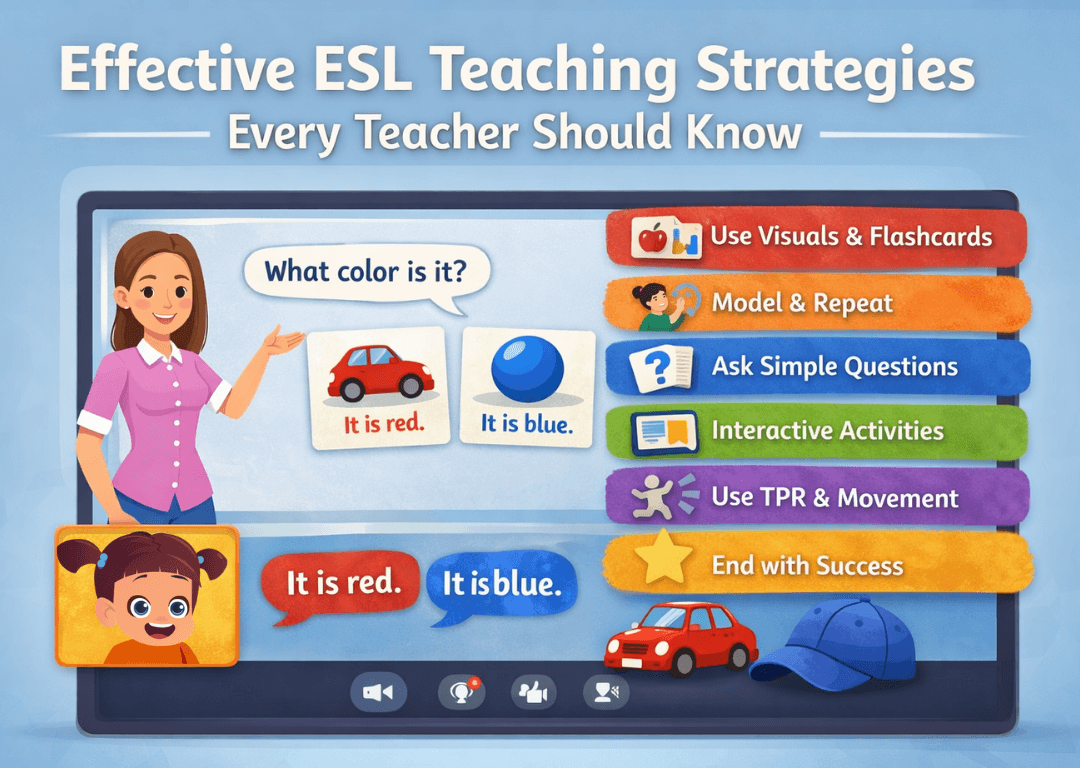
Teaching English as a Second Language can be one of the most rewarding careers but it can also be one of the most challenging. To be effective, understanding and applying a variety of ESL teaching strategies is essential. Every ESL teacher, whether teaching online or face-to-face, eventually asks the same question:
What are the most effective ESL teaching strategies that truly help students learn faster and speak more confidently?
The answer isn’t about teaching more. It’s about teaching smarter.
In this guide, we’ll explore practical, classroom-tested ESL teaching strategies that work for beginners and young learners. We’ll also look at a real lesson example using structured, interactive slides from English Bright to show how these strategies work in action.

(Click the image to view the lesson)
1. Keep Language Simple and Focused
One of the most powerful ESL teaching strategies is simplicity.
Many new teachers try to introduce too much vocabulary or too many grammar rules in one lesson. But ESL learners, especially beginners, need:
- Clear vocabulary
- One simple sentence pattern
- Repetition
- Visual support
When teaching strategies for ESL learners, clarity always wins over complexity.
For example, instead of teaching five colors at once, focus on just two. That focus increases retention and builds confidence.
2. Use Visual-Based Learning
Visual learning is one of the most effective strategies for teaching ESL students.
Young learners especially process language better when they see it connected to images. Flashcards, slides, gestures, and color-coded visuals dramatically increase understanding.
Example Lesson: Teaching Colors (Red and Blue)
In this lesson, students will learn about the colors red and blue.
The key sentence patterns are:
- “What color is it?”
- “It is red.”
- “It is blue.”
Using visual slides, the teacher shows:
- A red apple
- A blue ball
- A red car
- A blue hat
Students visually associate the word with the object. This reduces translation dependence and strengthens direct language comprehension a key ESL teaching strategy.
3. Model Before Expecting Output
One of the most overlooked ESL teaching strategies is proper modeling.
Before asking students to answer independently, teachers should:
- Say the sentence clearly.
- Gesture naturally.
- Repeat with emphasis.
- Have students repeat together.
- Then ask individually.
For example:
Teacher: “What color is it?”
Teacher answers: “It is red.”
Students repeat together.
Then individual students answer.
This gradual release method is one of the most reliable teaching strategies for ESL students because it reduces anxiety and builds structured confidence.
4. Repetition Without Boredom
Repetition is essential but it doesn’t have to be boring.
Effective ESL teaching strategies include repetition through variation:
- Choral repetition
- Whisper voice
- Loud voice
- Fast speed
- Slow motion
- Boy vs. girl team
- Teacher vs. student game
Using the red and blue lesson example, teachers can repeat:
“What color is it?”
“It is blue.”
But each repetition feels fresh and interactive.
This keeps engagement high while reinforcing language patterns.
5. Ask Structured Questions
Random questions create confusion. Structured questions create progress.
One of the strongest strategies for teaching ESL learners is to control the language environment.
Instead of asking:
“What do you see?”
Ask:
“What color is it?”
The more structured the question, the higher the success rate.
In early ESL stages, predictability builds confidence. Once students master one structure, teachers can gradually expand.
6. Use Interactive Slides Instead of Static PDFs
Modern ESL teaching strategies emphasize interactivity.
Interactive slides allow teachers to:
- Click to reveal answers
- Animate objects
- Play sound effects
- Highlight target words
In a structured lesson like the red and blue example, students might:
- Click the correct color
- Drag a red object into a box
- Circle blue items
This transforms passive learning into active participation which dramatically improves retention.
For online teachers especially, interactive materials prevent screen fatigue and increase student focus.

(Click the image to view the lesson)
7. Scaffold Sentence Patterns
Scaffolding is a key ESL teaching strategy that ensures students move from supported speech to independent speech.
In the color lesson, the progression might look like this:
Step 1:
Teacher asks and answers.
“What color is it? It is red.”
Step 2:
Teacher asks, students answer together.
Step 3:
Teacher asks, one student answers.
Step 4:
Teacher shows new object, student asks and answers.
Step 5:
Students ask each other.
This gradual independence is one of the most effective teaching strategies for ESL students because it builds fluency without overwhelming them.
8. Incorporate Movement and TPR
Total Physical Response (TPR) is one of the most widely used ESL teaching strategies worldwide.
Students remember language better when they move.
For example:
Red = Touch something red in your room.
Blue = Point to something blue.
You can even turn it into a quick game:
Teacher says: “Find something red!”
Students run and grab a red object.
This physical engagement increases memory retention and keeps energy high especially with younger learners.
9. Maintain a Clear Lesson Structure
Great ESL teaching strategies follow a predictable structure.
A simple 5-step format works well:
- Introduce vocabulary
- Model sentence pattern
- Guided repetition
- Interactive practice
- Quick review
Using the red and blue lesson:
- Introduce red and blue with images
- Model “What color is it?”
- Repeat as a class
- Play a color guessing game
- End with rapid-fire review questions
Consistency builds comfort. Comfort builds confidence.
10. End Every Lesson with Success
One of the most powerful yet simple ESL teaching strategies is ending on a high note.
Before class ends, review:
“What color is it?”
“It is red.”
“It is blue.”
Ask a few easy questions students can answer successfully.
Success at the end of class creates positive emotional association with English learning and that emotional connection is what keeps students motivated long term.

Why These ESL Teaching Strategies Work
These ESL teaching strategies work because they:
- Reduce cognitive overload
- Focus on one clear target
- Build repetition through engagement
- Provide visual support
- Scaffold output
- Encourage movement
- Maintain structured progression
When teaching strategies for ESL learners are predictable, interactive, and simple, students learn faster and feel more confident speaking.
The Difference Between Random Materials and a Teaching System
Many teachers struggle not because they lack skill but because they lack structure.
Scattered PDFs, disconnected worksheets, and unorganized files increase prep time and reduce lesson flow.
Modern strategies for teaching ESL students emphasize:
- Organized lesson progression
- Interactive materials
- Clear sentence pattern focus
- Visual support
- Repeatable structure
When teachers follow a system, ESL teaching strategies become easier to apply consistently.
Final Thoughts
Effective ESL teaching strategies are not about being flashy. They are about being intentional.
If you focus on:
- Simplicity
- Structure
- Repetition
- Visual learning
- Scaffolded output
You will see stronger results in your ESL classroom.
Even a simple lesson about red and blue can become powerful when taught with the right ESL teaching strategy.
The goal isn’t to impress students with complexity.
The goal is to help them confidently answer:
“What color is it?”
“It is red.”
“It is blue.”
When students can speak clearly, confidently, and independently that’s when you know your ESL teaching strategies are working.



Leave a Reply