
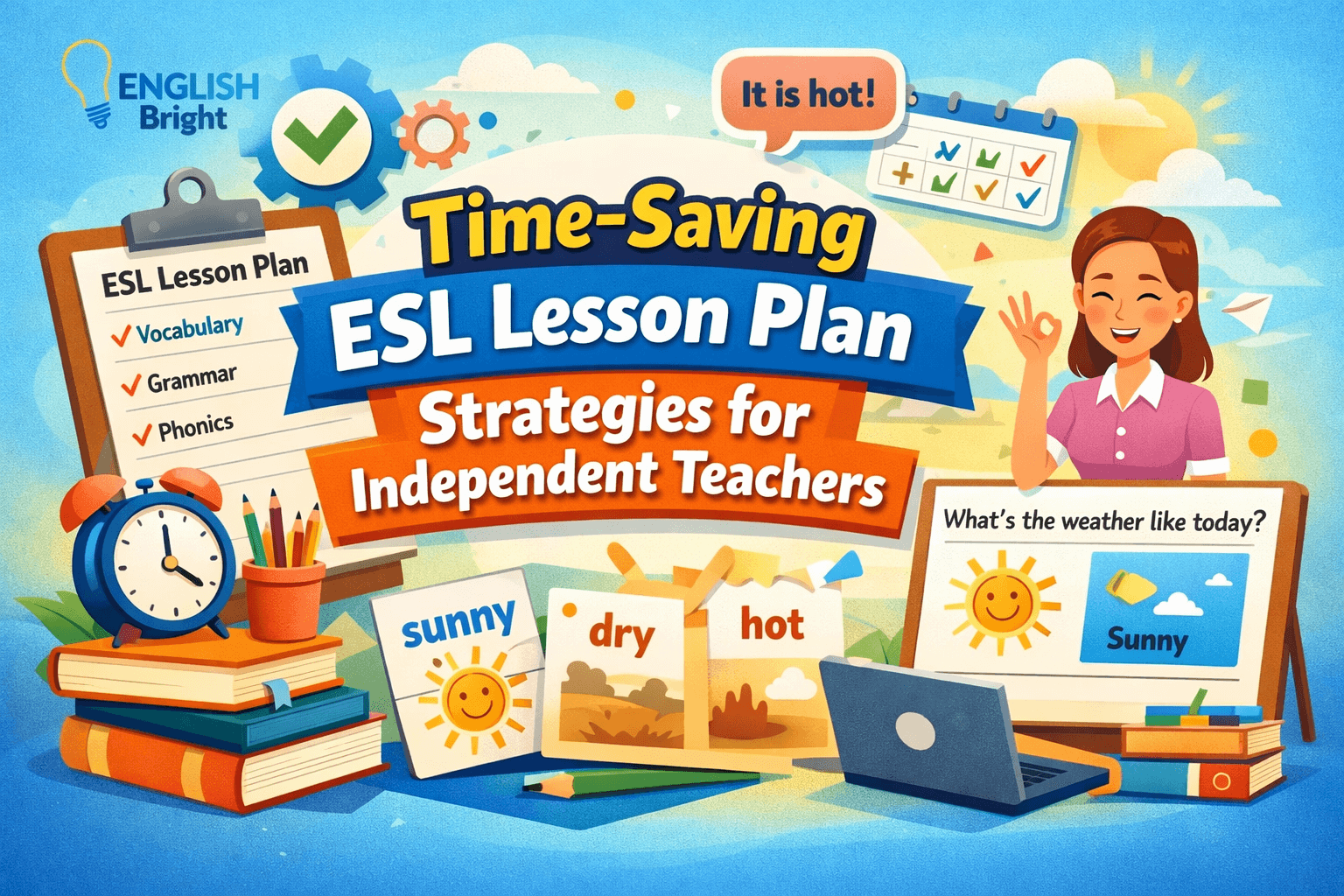
Creating an effective ESL lesson plan takes time, creativity, and structure especially for independent teachers managing their own schedules, materials, and students. Unlike teachers working in large ESL companies, independent educators must design, organize, and deliver lessons efficiently while maintaining high quality.
The good news? You don’t have to reinvent the wheel every week.
In this guide, you’ll discover practical, time-saving strategies to build powerful ESL lesson plans that are structured, engaging, and reusable. We’ll also look at how ready-made resources like English Bright ESL lessons can dramatically reduce preparation time while maintaining strong learning outcomes.
Why Independent Teachers Need a Smart ESL Lesson Plan System
If you’re teaching independently, your time equals income. Every hour spent over-preparing is unpaid time. A strong ESL lesson plan should:
- Be reusable and adaptable
- Follow a predictable structure
- Target vocabulary, grammar, phonics, and speaking practice
- Minimize prep while maximizing student engagement
Without a system, planning can become overwhelming. With a system, planning becomes streamlined.
Strategy 1: Use a Repeatable Lesson Framework
One of the biggest time-saving strategies is using a consistent structure for every ESL lesson plan. When students recognize the flow of the lesson, transitions become smoother and classroom management improves.
Here’s a simple 6-step framework you can reuse:
- Warm-Up Review
- Vocabulary Introduction
- Sentence Pattern Practice
- Grammar Focus
- Phonics Practice
- Speaking Activity & Wrap-Up
By following this format weekly, you reduce decision fatigue. You already know what comes next.
Strategy 2: Build Thematic ESL Lesson Plans
Thematic lessons save planning time because vocabulary, grammar, and activities naturally connect.
For example, let’s look at a Weather-Level 3 Unit 2-Lessons 1, a Themed ESL Lesson Plan using structured content similar to English Bright’s approach.

Lesson Focus: Weather
Vocabulary:
- weather
- sunny
Key Sentence Pattern:
- “What’s the weather like today?”
Verb:
- shine
Sight Words:
- its
- dry
- hot
Grammar Focus:
- Using adjectives to describe the weather
Phonics Focus:
- Initial and final “p” sounds
Instead of planning separate vocabulary, grammar, and phonics lessons, you integrate everything into one theme. This saves preparation time and improves retention.
Strategy 3: Use Ready-Made Structured Lessons
One of the most effective ways to save time is using structured resources like English Bright ESL lessons.
English Bright lessons are designed with:
- Clear vocabulary goals
- Defined sentence patterns
- Sight word integration
- Grammar focus
- Phonics reinforcement
- Speaking practice
For example, in the weather lesson described above, students:
- Learn the vocabulary words weather and sunny
- Practice the sentence: “What’s the weather like today?”
- Learn the verb shine
- Study sight words: its, dry, hot
- Focus on adjectives for description
- Practice identifying initial and final “p” sounds
This integrated structure means you don’t have to design each component separately. The lesson already aligns vocabulary, grammar, phonics, and speaking.
Instead of spending 2–3 hours planning, you can adapt and teach in under 30 minutes of prep time.
Strategy 4: Integrate Phonics Without Adding Extra Prep
Many independent teachers spend extra time creating separate phonics lessons. Instead, integrate phonics directly into your main lesson.
In the weather lesson example:
- Use the word “map” for final “p”
- Use “pen” for initial “p”
- Have students identify whether the “p” sound is at the beginning or end
By connecting phonics to your main vocabulary practice, you avoid planning separate phonics sessions.
This makes your ESL lesson plan more efficient and cohesive.
Strategy 5: Use Predictable Question Patterns
Time-saving teaching is not only about preparation—it’s also about classroom flow.
Using consistent question patterns like:
- “What’s the weather like today?”
- “Is it sunny?”
- “Is it hot?”
Students learn to respond automatically, which reduces explanation time and increases speaking practice.
You can also extend:
- “It is sunny.”
- “It is hot and dry.”
- “The sun shines.”
Repetition builds confidence and reduces the need to reteach instructions.
Strategy 6: Focus on High-Impact Grammar
Independent teachers often over-plan grammar explanations. Keep grammar simple and practical.
In the weather lesson:
Instead of teaching all adjective rules, focus only on:
- “It is + adjective.”
- It is sunny.
- It is hot.
- It is dry.
That’s enough for beginner learners.
A focused grammar target keeps your ESL lesson plan manageable and effective.
Strategy 7: Plan for Reusability
The best ESL lesson plans are reusable year after year.
Ask yourself:
- Can I use this lesson next month?
- Can I use this lesson with another student?
- Can I adapt this lesson for online teaching?
For example, the weather lesson can be reused:
- During different seasons
- For daily warm-ups
- As part of a larger “Seasons” unit
- For online classes with slides
Reusable lessons reduce long-term workload significantly.

Leave a Reply