
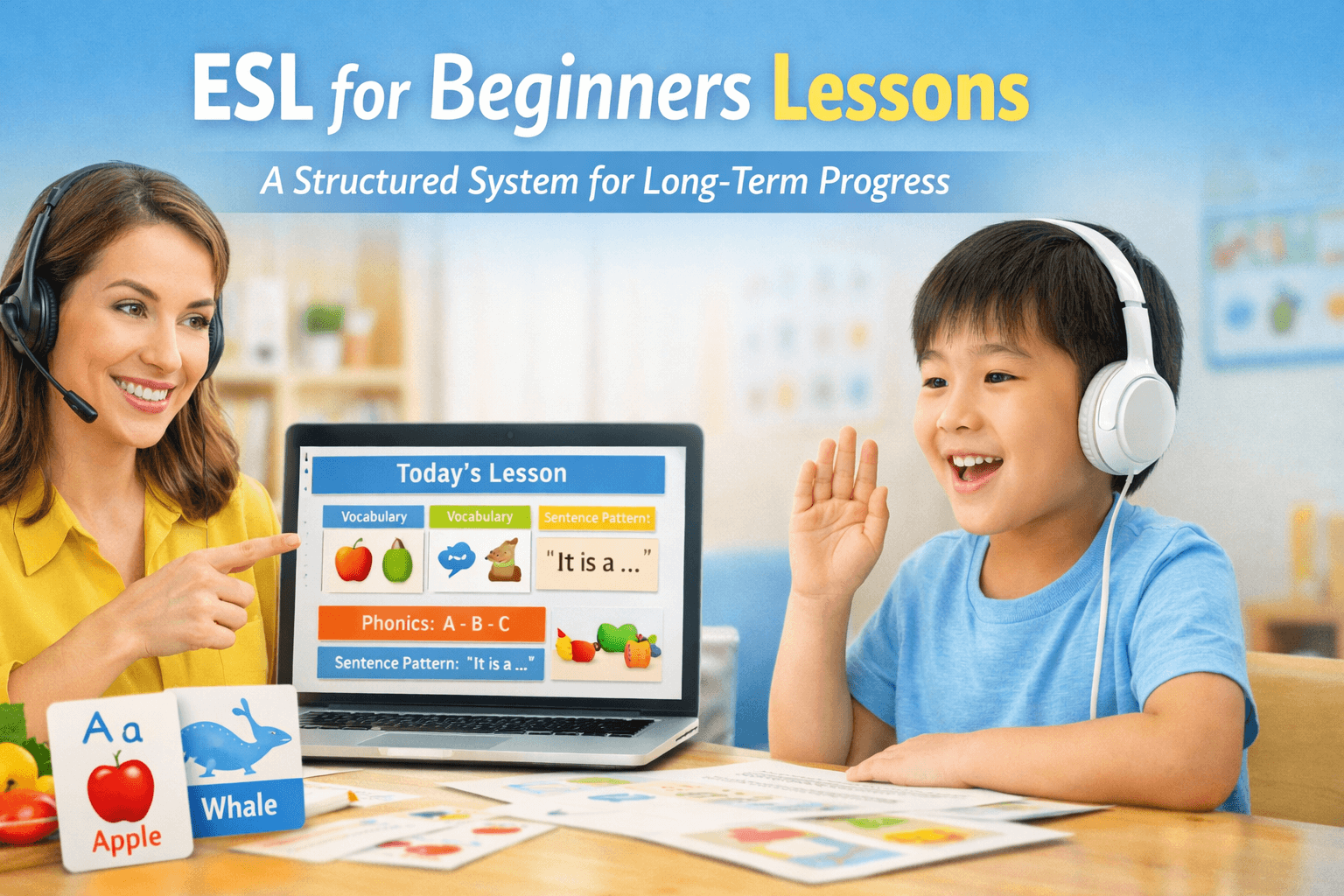
Teaching beginners is one of the most important stages in language education. At this level, students are not refining English — they are building it from the ground up. For this reason, esl for beginners lessons must follow a clear and structured system if teachers want to see long-term progress.
Many educators search for creative esl lessons for beginners, hoping to find engaging activities or quick classroom ideas. While activities are helpful, beginners need more than isolated games. In fact, they require consistency, repetition, and a learning pathway that connects vocabulary, pronunciation, and sentence formation in a logical way.
Without structure, progress often feels slow and scattered. With structure, however, beginners gain confidence step by step. This article explains how to design effective esl lesson ideas for beginners and why a structured system leads to stronger speaking ability, better retention, and visible long-term improvement.
Why Structure Is Essential for Beginner Learners
At the beginner stage, students are learning everything for the first time. They are not only memorizing words; rather, they are discovering how English sounds, how sentences are formed, and how communication works.
To build a strong foundation, learners must gradually develop:
- Core vocabulary
- Phonics awareness
- Sentence patterns
- Sight word recognition
- Basic grammar understanding
- Listening comprehension
- Speaking confidence
When esl for beginners lessons are disconnected from one another, students may remember individual words but struggle to form complete sentences. As a result, they might repeat after the teacher yet hesitate when asked to speak independently. A structured system prevents this problem because each lesson builds naturally on the previous one.
What Effective ESL for Beginners Lessons Include
Strong beginner lessons are predictable and organized. Consequently, students feel safer and more confident when they know what to expect.
In a structured beginner system, lessons should consistently include:

- Vocabulary introduction
- Phonics practice
- Sentence pattern modeling
- Sight word exposure
- Grammar in context
- Guided speaking
- Independent speaking
These components must work together. For example, teaching vocabulary without sentence patterns limits speaking ability. Similarly, presenting grammar without repetition can overwhelm beginners. In addition, teaching phonics without meaningful words reduces engagement. Therefore, balance is essential.
In English Bright ESL structured lessons for beginner-level students, each lesson consists of vocabulary, phonics, sentence patterns, sight words, and grammar. Because these elements are integrated into every class, learners develop complete language foundations rather than isolated knowledge.
Building Vocabulary That Connects to Real Communication
Vocabulary is often the starting point of esl lessons for beginners. Common beginner topics include the alphabet, animals, fruits, colors, and classroom objects. However, vocabulary should never stand alone.
For example, when teaching fruits, students should not only learn:
- Apple
- Banana
- Orange
- Mango
Instead, they should practice speaking in full sentences such as:
- “It is an apple.”
- “I like bananas.”
- “This is a mango.”
- “It is sweet.”
This shift from word recognition to sentence production marks the beginning of real progress. Likewise, beginner topics such as alphabet, sea animals, family, numbers, and colors must connect to repeatable sentence patterns. As a result, students gain the tools they need to speak confidently.
The Importance of Phonics in Beginner Lessons
Phonics plays a critical role in long-term success. Without phonics awareness, reading becomes difficult and pronunciation remains inconsistent. Therefore, structured esl for beginners lessons should introduce phonics gradually and systematically.
Students should practice:
- Letter recognition
- Initial sounds
- Blending simple sounds
- Pronunciation accuracy
For instance, in an alphabet unit, learners do more than memorize letters. Instead, they connect sounds to simple words, which strengthens both reading readiness and speaking clarity. Most importantly, phonics should reinforce vocabulary learning rather than exist separately from it.
Sentence Patterns: The Bridge to Speaking Confidence
One common mistake in beginner teaching is focusing only on vocabulary lists. Although students may know several words, they often cannot form a single sentence. This is where sentence patterns become essential.
Beginner-friendly patterns include:
- “It is a ___.”
- “I see a ___.”
- “This is my ___.”
- “I like ___.”
- “What is this?”
When these patterns repeat across different units, students become more fluent. Over time, they respond faster and with greater confidence. Furthermore, revisiting sentence structures while changing vocabulary builds automaticity and long-term retention.
Sight Words and Grammar in Context
Early exposure to sight words significantly improves reading fluency. Words such as is, a, my, like, see, and the appear frequently in beginner sentences. Because students encounter them repeatedly, recognition becomes automatic.
Grammar instruction at this level should remain simple and contextual. Rather than giving long explanations, teachers model correct structures:
- “It is a dog.”
- “They are cats.”
- “I am happy.”
Through consistent exposure and guided practice, learners internalize grammar naturally. When vocabulary, phonics, sentence patterns, sight words, and grammar work together, language becomes meaningful and usable.
The Power of Unit-Based Learning
Long-term progress requires more than isolated lessons. Instead, students benefit from organized, unit-based learning that follows a logical progression.
English Bright ESL Level 1 is designed specifically for beginners and consists of:

- 12 structured units
- 353 structured lessons
These units include foundational topics such as Alphabet, Sea Animals, Fruits, and many others. Because the curriculum spirals vocabulary and sentence patterns, students gradually move from recognition to repetition and finally to independent production.
For example, in a Sea Animals unit, learners might study:
Vocabulary:
Fish, Whale, Crab, Shark
Sentence patterns:
“It is a fish.”
“I see a whale.”
“The crab is red.”
Phonics:
F sound in fish
W sound in whale
Sight words:
is, a, the
Grammar:
Singular noun structures
This layered approach ensures that multiple language skills develop simultaneously.
Repetition Without Boredom
Although beginners need repetition, repeating the same activity can reduce engagement. Instead, structured repetition changes the activity format while maintaining consistent sentence patterns.
For example:
Pattern: “What is this? It is a ___.”
Activity variations may include:
- Flashcard speaking
- Quick-response games
- Drawing and describing
- Partner question practice
- Online interactive slides
Because the structure remains stable, fluency improves. At the same time, varied activities keep students motivated.
From Words to Independent Speaking
Long-term beginner growth follows clear stages:
- Word recognition
- Sentence repetition
- Guided speaking
- Independent sentence production
- Simple question-and-answer exchange
When esl lesson ideas for beginners follow a structured system, students move naturally through these stages. For instance, a learner who begins with the word “apple” can eventually say:
- “It is an apple.”
- “I like apples.”
- “Do you like apples?”
Such progression does not happen by accident. Rather, it results from consistent, connected instruction.
Why Random ESL Lessons Slow Down Progress
Many teachers collect creative activities from various sources. While these ideas may be engaging, they often lack continuity. Consequently, vocabulary may be forgotten quickly and sentence patterns may change too frequently.
When lessons feel random:
- Vocabulary is forgotten faster
- Sentence patterns lack consistency
- Students hesitate during speaking
- Progress appears unclear
In contrast, a structured beginner pathway promotes steady improvement. Because lessons follow a repeatable framework, students retain more, respond faster, and feel more capable. Moreover, parents can clearly see measurable growth.
Measuring Beginner Progress
So how can you determine whether your esl for beginners lessons are effective?
Look for these indicators:
- Students answer in full sentences without prompting
- Pronunciation becomes clearer
- Response time improves
- Learners ask simple questions
- Participation increases
Ultimately, confidence is the strongest sign of progress. When beginners feel successful, they speak more — and speaking remains the ultimate goal.
Why a Structured System Creates Long-Term Results
Long-term progress does not happen through isolated lesson ideas. Instead, it occurs when vocabulary, phonics, sentence patterns, sight words, and grammar work together consistently.
A system built around 12 organized units and 353 structured lessons ensures that:
- Learning is cumulative
- Patterns repeat strategically
- Vocabulary spirals naturally
- Teachers save preparation time
- Students build strong foundations
Rather than guessing what to teach next, educators follow a clear roadmap. As a result, structure creates clarity. Clarity builds confidence. Confidence leads to communication.
When esl for beginners lessons follow a structured system, students move from first words to meaningful sentences with steady, visible progress. And ultimately, that is how long-term success begins.

Leave a Reply