
If you search online for conversation prompts ESL, you’ll find endless lists of questions. Some are creative. Some are fun. Some are designed for beginners, others for advanced learners. But many ESL teachers discover the same problem:
The prompts look good on paper…
Yet students still give short answers.
Or stay silent.
Or respond with just one word.
The issue isn’t that conversation prompts don’t work. It’s that they’re often used without structure.
For ESL teachers, especially those teaching young learners or lower-intermediate students, speaking development doesn’t happen through random questioning. It happens through intentional design. When conversation prompts ESL are structured around vocabulary, sentence patterns, and repetition, they become powerful tools for fluency rather than awkward classroom fillers.
Let’s explore what that looks like in practice.

Why Many ESL Conversation Prompts Fall Flat
A common classroom moment goes like this:
Teacher: “What do you do every morning?”
Student: “…Eat.”
Teacher: “Okay… what else?”
Student: “…School.”
Technically, the student understood. But linguistically, they weren’t prepared to produce a full sentence with confidence.
This is where many ESL conversation prompts fail. They expect students to generate language they haven’t fully internalized yet.
When learners hear a question like:
“What do you do every morning?”
They must decode the question, choose correct vocabulary, select the right verb form, organize the sentence structure, and then speak clearly all within seconds. Without scaffolding, this cognitive load is overwhelming.
That’s why effective conversation prompts for ESL students are not random. They are aligned with recently taught vocabulary and sentence patterns. They build upward, not outward.
The Power of Structured Speaking
Instead of beginning with broad, open-ended questions, structured speaking starts with focus.
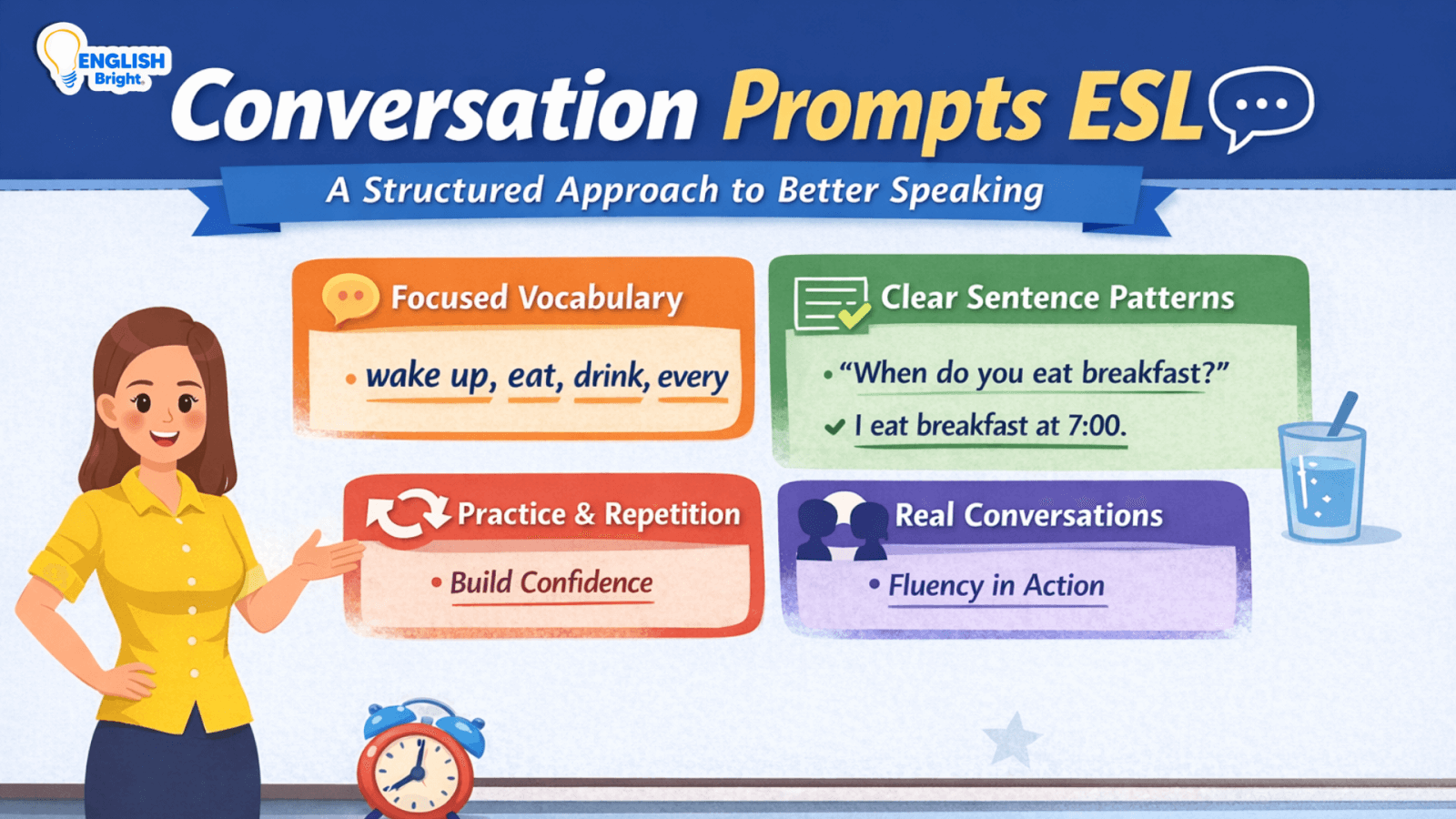
Consider a lesson centered on daily routines. The core verb is “wake up.” Supporting vocabulary includes sight words such as eat, drink, every, and wake up.
Rather than asking:
“Tell me about your day.”
A structured approach introduces clear patterns like:
- “When do you eat breakfast?”
- “When do you wash your face?”
Immediately, students are supported. The question is predictable. The grammar is visible. The vocabulary has already been practiced.
Now, when students answer:
“I eat breakfast at 7:00.”
“I wash my face at 6:30.”
They are not guessing. They are applying.
That difference transforms the effectiveness of conversation prompts ESL.
Why Sentence Patterns Matter
One of the biggest mistakes teachers make with ESL conversation prompts is assuming that students will naturally build full responses. In reality, sentence patterns must be taught explicitly.
For example, with the daily routine topic, students practice:
- “I wake up at 7:00.”
- “I eat breakfast every day.”
- “I drink milk in the morning.”
By rehearsing these patterns before conversation begins, learners develop automaticity. When the teacher asks:
“When do you wake up?”
The student’s brain already knows the structure:
“I wake up at…”
This predictability reduces anxiety and increases fluency.
Without structure, conversation prompts can feel like tests. With structure, they feel like practice.

Sight Words and Fluency Development
Sight words such as eat, every, drink, and wake up may seem simple, but they play a critical role in speaking development.
When students can instantly recognize and use words like every, their responses become more natural.
These small expansions move learners from robotic answers to conversational rhythm.
Effective conversation prompts for ESL students intentionally recycle sight words within meaningful contexts. This repetition strengthens recall and supports smoother speech production.
From Controlled Practice to Natural Conversation
Structured speaking does not mean rigid speaking. It means guided progression.
After practicing:
- “When do you eat breakfast?”
- “When do you wash your face?”
Teachers can slightly expand the prompt while staying within the same language framework:
- “Do you wake up early or late?”
- “Do you drink water before school?”
Because students already know the verb wake up and the sight words, they can adjust their answers without panic.
Gradually, this leads to more open variation:
- “What do you do after you wake up?”
Now the student has a linguistic anchor. They aren’t speaking from zero. They’re building from familiarity.
That is the essence of successful conversation prompts ESL progression without overwhelm.
The Emotional Side of Speaking
ESL teachers often focus on grammar and vocabulary, but speaking confidence is deeply emotional.
When students feel unsure about structure, they hesitate. When they hesitate, they speak less. When they speak less, their fluency stagnates.
Structured ESL conversation prompts reduce that emotional barrier.
When learners recognize the pattern, they feel safe. When they feel safe, they participate. When participation increases, fluency develops naturally.
This is especially important for Level 3 learners, students who already know basic vocabulary but struggle to transform knowledge into speech.
At this stage, speaking confidence is fragile. Clear structure strengthens it.

Why Daily Routine Topics Work So Well
Daily routine lessons are ideal for structured conversation prompts ESL because:
- The vocabulary is relatable.
- The time-based answers are predictable.
- The verbs are repetitive and easy to expand.
With a focus on “wake up,” teachers can easily connect related actions:
- wake up
- wash your face
- eat breakfast
- drink water
Because these actions happen every day, students can personalize their answers without searching for new vocabulary.
Personalization plus repetition equals retention.
Avoiding the “Interview Trap”
Another common issue with conversation prompts for ESL students is turning class into an interrogation.
Teacher: “When do you wake up?”
Teacher: “When do you eat breakfast?”
Teacher: “When do you wash your face?”
If the interaction remains teacher-centered, students don’t truly practice conversation.
Instead, structured prompts should transition into peer interaction:
Student A: “When do you wake up?”
Student B: “I wake up at 7:00.”
Now both students are speaking. Both are using the target verb. Both are reinforcing the pattern.
The conversation is simple but meaningful.
How Structure Supports Long-Term Fluency
Fluency isn’t built by complexity. It’s built by repetition within clear frameworks.
When teachers consistently use structured conversation prompts ESL, students begin to internalize patterns:
- I wake up at…
- I eat… at…
- I drink… every…
Over time, these patterns transfer to new topics. The brain becomes comfortable with constructing complete sentences.
This is why structured prompts are more powerful than random question banks. They create habits, not just answers.
Designing Better ESL Conversation Prompts
When planning your next speaking lesson, ask yourself:
- Does this prompt match recently taught vocabulary?
- Is the sentence pattern clear?
- Have students practiced the structure before answering freely?
If the answer is yes, your ESL conversation prompts will likely succeed.
If the answer is no, you may encounter silence or confusion.
Conversation design is not about creativity alone. It is about alignment.

Final Thoughts: Better Prompts, Better Speaking
The goal of using conversation prompts ESL is not to fill classroom time or create artificial discussions. It is to help students build reliable speaking patterns they can use confidently.
When prompts are connected to:
- A focused verb like wake up
- Clear sentence patterns such as “When do you eat breakfast?”
- Sight words like eat, every, drink, and wake up
Students respond with structure, not stress.
For ESL teachers, especially those teaching young learners and lower-intermediate students, this structured approach makes speaking practice predictable, calm, and productive.
Instead of asking more questions, design better ones.
Because confident speaking doesn’t begin with randomness.
It begins with structure.
And when structure is in place, conversation flows naturally.


Leave a Reply