
Teaching the alphabet is one of the most fundamental steps in helping young learners build a strong foundation in English. However, traditional methods—relying heavily on repetition and worksheets—can quickly become monotonous for students. This is why alphabet games ESL teachers can use in class are essential tools to make learning both fun and effective. Incorporating interactive activities engages students, improves retention, and encourages more participation, especially in online environments.
Using fun alphabet games ESL for young learners not only enhances letter recognition but also strengthens pronunciation, vocabulary, and speaking confidence. Interactive games transform simple alphabet practice into exciting challenges, allowing students to actively participate rather than passively memorize letters. Whether teaching in a physical classroom or conducting interactive alphabet games for ESL online classes, these activities foster engagement and make learning a memorable experience.
Why Alphabet Games Are Essential in ESL Learning
Young learners thrive when learning is interactive. Repetition alone often leads to disengagement, especially for kindergarten students or beginners. By using ESL alphabet games for kindergarten students, teachers can create a dynamic learning environment that combines movement, visuals, and sounds, helping students retain knowledge more effectively.
Alphabet games also provide a safe space for learners to practice speaking. Many children are shy and hesitant to pronounce letters aloud in a traditional setting. With alphabet pronunciation games ESL, students are encouraged to speak confidently in a playful, low-pressure context. Games also support listening skills, improve vocabulary, and enhance letter recognition in a natural and enjoyable way.
Common Challenges in Teaching the Alphabet
Despite its importance, teaching the alphabet can be challenging. Many teachers face issues like:
- Limited student participation
- Low retention of letters and sounds
- Passive learning during repetitive drills
- Short attention spans, especially in online classes
These challenges can be overcome by incorporating online alphabet games for ESL students that encourage active engagement, quick responses, and collaboration.
How Interactive Alphabet Games Improve Student Participation
Engagement is key to language acquisition. Interactive activities stimulate curiosity, challenge students, and create a sense of achievement. Alphabet games to improve ESL student participation are particularly effective because they transform passive learning into active involvement. Students respond to prompts, compete in friendly challenges, and receive immediate feedback, which encourages more speaking, listening, and critical thinking.
Interactive games also provide multisensory experiences. For instance, when children see letters on the screen, hear their pronunciation, and physically respond or point to letters, they form stronger mental connections. This combination of visual, auditory, and kinesthetic learning is particularly effective for digital ESL alphabet games for primary students.
Best Alphabet Games ESL Teachers Can Use
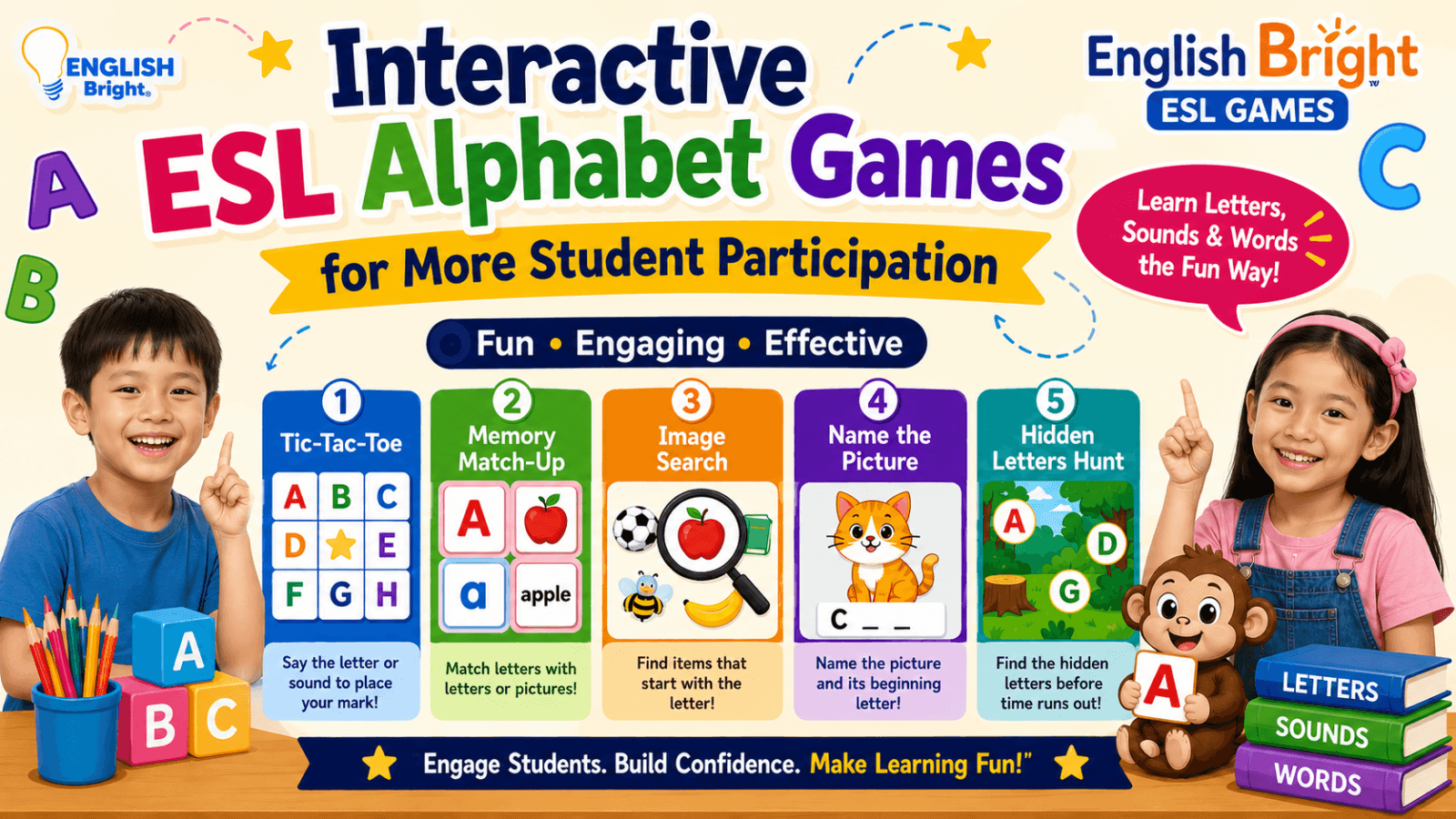
Here are five proven alphabet games ESL teachers can use in class to maximize engagement and learning outcomes. These games are fully compatible with English Bright ESL Games, making it easy for teachers to incorporate ready-made interactive lessons.
1. Tic-Tac-Toe Alphabet Game

Tic-Tac-Toe is a simple yet powerful tool for reviewing letters. Teachers divide the board into nine squares and place letters inside each one. Students must correctly identify or pronounce the letter before placing their X or O. This activity encourages friendly competition while reinforcing letter recognition, pronunciation, and participation. It’s an ideal choice for easy alphabet games for ESL online lessons, providing excitement without sacrificing learning outcomes.
2. Memory Match-Up

Memory games are excellent for reinforcing letter recognition and building vocabulary. Students match uppercase and lowercase letters or pair letters with corresponding images (e.g., A → Apple). Repetition occurs naturally through gameplay, which helps students retain letters and sounds more effectively. ESL letter recognition games for kids like Memory Match-Up also encourage focus, attention to detail, and critical thinking.
3. Image Search

Image Search is particularly effective in online classes. Teachers display a variety of images, and students must quickly identify objects that begin with a target letter. For example, “Find something that starts with B!” Students may answer with “Ball,” “Banana,” or “Bird.” This activity reinforces both vocabulary and ESL alphabet vocabulary games, while keeping learners engaged and active.
4. Name the Picture

Name the Picture is a straightforward but highly effective activity. Students view a picture and identify the starting letter or say the word aloud. For example, showing a picture of a dog prompts students to say “D” or “Dog.” This activity strengthens letter recognition, pronunciation, and vocabulary, making it a highly recommended alphabet games for ESL learners.
5. Hidden Letters Hunt

Hidden Letters Hunt turns letter recognition into a fun adventure. Letters are hidden around the screen or classroom, and students must find them. Teachers can add timers, points, or rewards to increase motivation. This game is perfect for energetic learners and is a great example of engaging alphabet games for online teaching. Hidden Letters Hunt also improves visual attention and reinforces the connection between letters and sounds.
Benefits of Using English Bright ESL Games
For teachers, preparation can be time-consuming. English Bright ESL Games provides ready-made interactive lessons that save hours of planning while ensuring students are actively learning. These games include all five activities mentioned above—Tic-Tac-Toe, Memory Match-Up, Image Search, Name the Picture, and Hidden Letters Hunt—along with interactive flashcards, puppet videos, and digital homework.
Key benefits include:
- Structured lessons for seamless teaching
- Engaging multimedia content for young learners
- Interactive exercises that encourage speaking and participation
- Easy-to-use digital tools for online and classroom lessons
By incorporating digital ESL alphabet games for primary students, teachers can provide a comprehensive learning experience that motivates students while simplifying their lesson planning.
Tips for Maximizing the Impact of Alphabet Games
- Keep instructions simple: Short and clear directions ensure students understand the task quickly.
- Encourage speaking: Always include opportunities for students to pronounce letters or say words aloud.
- Incorporate movement: Pointing, jumping, or gesturing while identifying letters reinforces learning.
- Rotate activities: Switching between different games every few minutes keeps students focused.
- Positive reinforcement: Praise efforts, not just correct answers, to build confidence.
These strategies enhance the effectiveness of interactive alphabet games for ESL online classes, creating a lively and supportive learning environment.
Final Thoughts
Incorporating alphabet games ESL teachers can use in class transforms traditional lessons into interactive, fun, and educational experiences. Games like Tic-Tac-Toe, Memory Match-Up, Image Search, Name the Picture, and Hidden Letters Hunt engage students, improve retention, and encourage active participation. Using English Bright ESL Games, teachers can save preparation time while offering highly interactive lessons that develop letter recognition, pronunciation, vocabulary, and confidence. By integrating these games into your ESL curriculum, you provide students with an engaging and effective way to master the alphabet, ensuring a strong foundation for future English learning.


Leave a Reply