
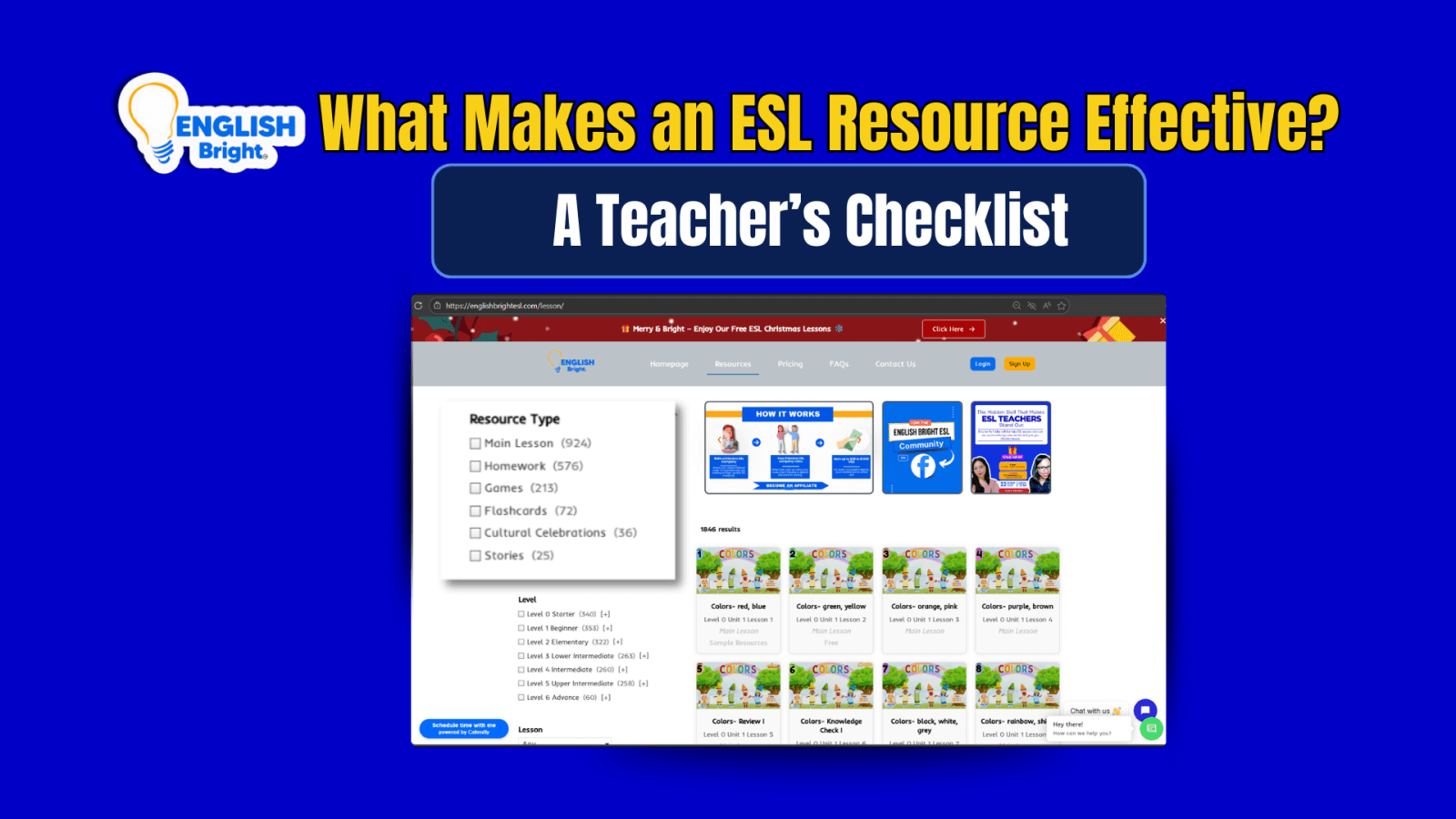
Choosing the right materials can make or break the success of an ESL lesson. With countless worksheets, videos, textbooks, apps, and online platforms available today, teachers often struggle to determine which resources for ESL teachers truly support learning—and which ones only add noise.
An effective ESL resource should do more than fill time. It should help students understand, practice, and confidently use English in meaningful ways. Whether you teach young learners, teens, or adults, having a clear checklist makes it easier to evaluate any resource and decide if it’s the correct fit for your lesson goals.
This guide outlines what every teacher should look for when selecting reliable and effective ESL resources.
Try this lesson with your students: Level 1, Unit 1 – Lesson 1: Alphabet

1. Alignment With Learning Objectives
The most important question to ask is:
“Does this resource support my lesson goal?”
A high-quality ESL resource should match:
- The vocabulary you’re teaching
- The grammar point or sentence pattern
- The skill focus (speaking, listening, reading, writing)
- The difficulty level of your learners
2. Level-Appropriate Content
Good resources for ESL teachers understand level differences. A mismatch in level can quickly lead to frustration or boredom.
Ask yourself:
- Is the vocabulary too basic or too advanced?
- Are the instructions clear enough?
- Can my students complete this independently or with support?
An effective resource should challenge students—but not overwhelm them.
3. Clear Instructions and Teacher Support
A resource should be easy to implement. If teachers need 15 minutes to figure out the instructions, it’s not efficient.
Look for:
- Simple directions
- Step-by-step procedures
- Examples or models
- Answer keys
- Teacher notes or suggestions
Clear guidance saves time and increases the quality of the lesson delivery.
4. Student Engagement and Interaction
ESL lessons work best when students are active participants. Effective resources should encourage students to speak, think, respond, and interact.
Strong indicators include:
- Speaking prompts
- Games or movement activities
- Role-play or communication tasks
- Visuals, audio, or interactive elements
If students are only filling out worksheets with no communication involved, the resource is not maximizing language use.
5. Cultural Relevance and Inclusivity
A good ESL resource respects diversity and helps students connect English to their real world.
Ask:
- Are the examples relatable to my students’ culture or age group?
- Are images and stories appropriate and inclusive?
- Does this avoid stereotypes or outdated content?
Culturally sensitive materials help students feel seen, included, and engaged.
6. Variety of Skills Practice
The best resources for ESL teachers offer balanced skill development.
Look for materials that include:
- Speaking activities for interaction
- Listening through audio or video
- Reading passages to build comprehension
- Writing practice for expression
- Vocabulary and grammar support
A strong resource doesn’t focus on just one skill—it connects multiple skills for deeper learning.
7. Opportunities for Real Communication
Effective ESL lessons allow students to use English for real purposes—not just memorization.
Examples of communicative tasks:
- Discussions and debates
- Interviews or surveys
- Story creation
- Problem-solving challenges
- Information gap activities
9. Visual Appeal and Organization
Students respond well to clear, visually appealing content.
Effective resources usually include:
- Clean layout
- Easy-to-read fonts
- Color-coded sections
- Relevant images or icons
- Minimal clutter
A good design supports comprehension and keeps learners focused.
10. Assessment and Reflection Opportunities
Strong ESL lessons include ways to check student understanding.
Look for resources that offer:
- Quick comprehension checks
- Formative assessment tasks
- Review or exit activities
- Knowledge Checks
Even simple check-ins help teachers measure progress and identify areas for improvement.
11. Consistency With Curriculum or Learning Path
If you follow a curriculum, the resource should fit into the sequence.
Ask:
- Does this support previous lessons?
- Does it build toward future topics?
- Does it reinforce the overall learning goals?
A resource may be excellent, but if it disrupts the progression, it won’t produce strong results.
12. Accessibility for All Learners
Good resources consider different learning styles and needs.
Look for:
- Audio for auditory learners
- Charts and visuals for visual learners
- Hands-on tasks for kinesthetic learners
- Clear language for struggling learners
An effective resource helps every student participate successfully.
Final Thoughts: A Reliable Checklist for ESL Teachers
Choosing the right materials isn’t about picking the flashiest or most popular option. It’s about selecting resources that truly support your teaching goals and help your students grow.
Here is your quick checklist:
✔ Aligned with learning objectives
✔ Level-appropriate
✔ Clear instructions
✔ Engaging and interactive
✔ Culturally relevant
✔ Balanced skill development
✔ Promotes real communication
✔ Flexible and adaptable
✔ Visually clear and organized
✔ Includes assessment opportunities
✔ Fits your curriculum
✔ Accessible for all learners
When ESL teachers use this checklist, choosing the right materials becomes easier, faster, and more intentional. The result? Stronger ESL lessons, more confident students, and smoother teaching overall.

Leave a Reply