
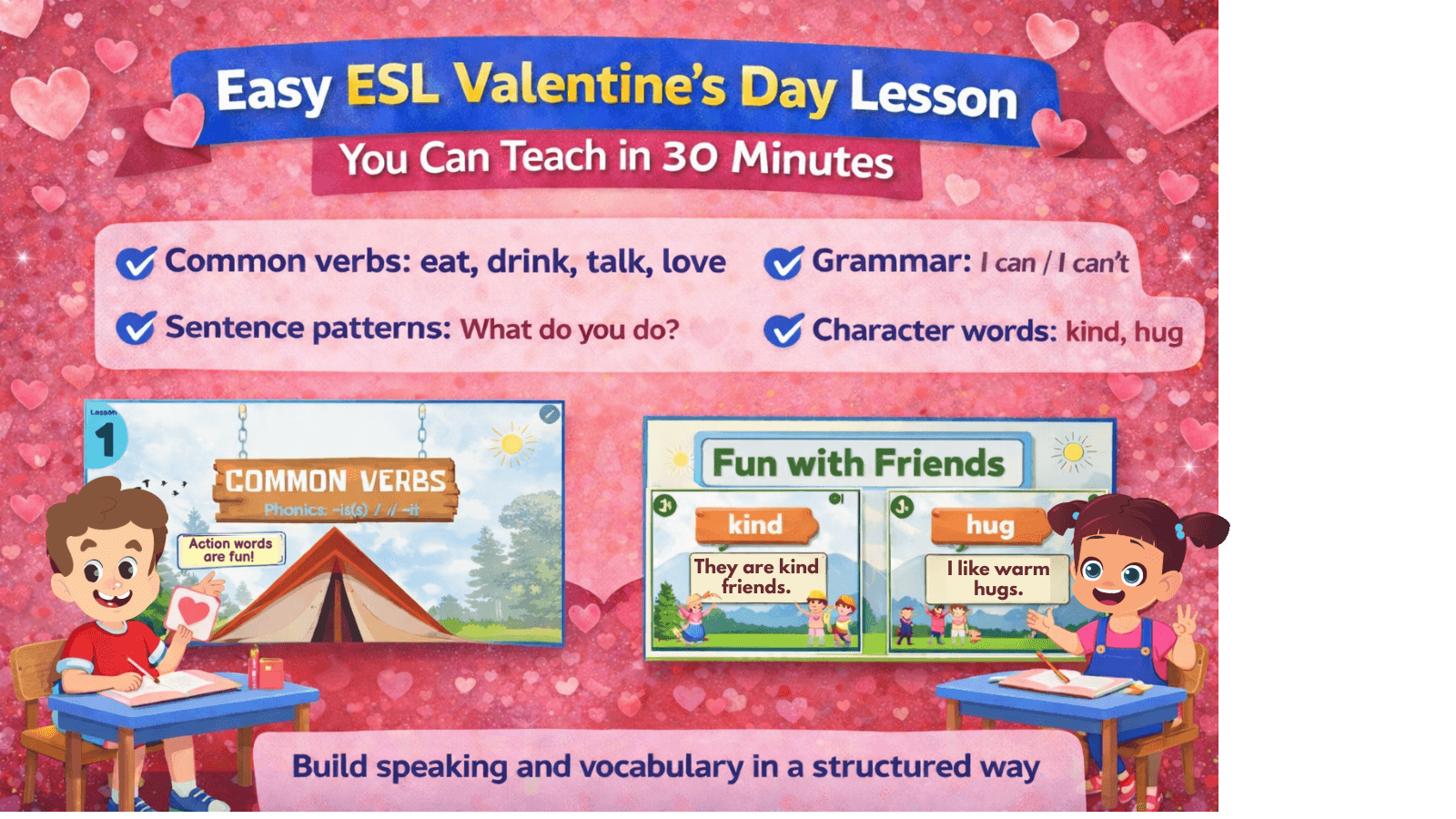
Valentine’s season is one of the easiest times of the year to create engaging language lessons. Students naturally connect to themes like love, friendship, kindness, and sharing. But many teachers overcomplicate it.
The truth is, you don’t need crafts, worksheets, or elaborate preparation. You can teach a structured, effective esl valentine’s day lesson in just 30 minutes using high-frequency verbs, simple sentence patterns, phonics practice, and speaking extension.
In this guide, we’ll walk through a complete, easy-to-follow esl valentine’s day lesson built around:
- Common verbs: eat, drink, talk, love
- Character words: kind, hug
- Sentence patterns
- Modal verbs (can / can’t)
- Phonics focus (-is and -im sounds)
- Speaking practice
This lesson builds vocabulary, grammar, pronunciation, and fluency all within one clear structure.
Lesson Overview (30 Minutes Total)
This esl valentine’s day lesson is divided into five simple sections:
- Warm-Up (5 minutes)
- Common Verbs Practice (10 minutes)
- Sentence Building + Grammar Focus (5 minutes)
- Kindness & Friendship Extension (5 minutes)
- Speaking Practice & Wrap-Up (5 minutes)
Let’s break it down step by step.
Step 1: Warm-Up – Action Words Are Fun (5 Minutes)
Start with the “Common Verbs” lesson slide showing:
- eat
- drink
- talk
- love
(Display the image with the Common Verbs board and phonics: -is(s) / -it.)
Ask students:
- What do you do every day?
- Do you eat?
- Do you drink?
- Do you talk to your friends?
Have them act out each verb.
This immediately energizes the class and activates prior knowledge.
Why This Works
These verbs are high-frequency and useful year-round. Instead of teaching random Valentine words like “chocolate” or “rose,” you’re reinforcing core language structures.
This makes your esl valentine’s day lesson purposeful and reusable beyond February.
Step 2: Sentence Pattern Practice (10 Minutes)
Now introduce the sentence structure:
What do you do?
→ I eat.
→ I drink.
→ I talk.
→ I love.
Have students repeat the question and answer.
Then extend:
- I eat cake.
- I drink juice.
- I talk to my friend.
- I love my mom.

This moves them from one-word answers to complete sentences.
Grammar Focus: Modal Verbs (I Can / I Can’t)
Introduce:
- I can talk.
- I can hug.
- I can help my friend.
- I can’t fly.
- I can’t drink coffee.
This adds complexity while still staying beginner-friendly.
You can connect this to Valentine’s themes:
- I can be kind.
- I can help my friend.
- I can give a hug.
This builds grammar naturally within the esl valentine’s day lesson.
Step 3: Phonics Focus – The “is” and “im” Sounds (5 Minutes)
Using your lesson slide that highlights phonics (-is and -im sounds), review:
- is
- his
- this
- I’m
Practice:
- She is kind.
- He is my friend.
- I’m happy.
- I’m kind.
Clap out the sounds:
- i + s = is
- i + m = im
This quick phonics reinforcement strengthens pronunciation and reading fluency.
Even in a seasonal lesson, phonics should not be skipped. It adds academic depth to your esl valentine’s day lesson.
Step 4: Character Words – Kind and Hug (5 Minutes)
Now display the “Fun with Friends” slides showing:
- kind
- hug

Introduce:
Kind
- She is a kind classmate.
- He is not a kind friend.
- They are kind friends.
Hug
- I like warm hugs.
- I hug my mom.
- I can hug my friend.
Now ask:
- Who is kind?
- Are you kind?
- Do you like hugs?
Encourage full sentence answers.
This makes the lesson personal and meaningful.
Step 5: Speaking Extension (5 Minutes)
Now combine everything.
Ask:
- Who do you love?
- What do you do with your friend?
- Is your friend kind?
- Can you help your friend?
Students respond using patterns practiced earlier.
Example answers:
- I love my sister.
- I talk to my friend.
- She is kind.
- I can help my mom.
This final speaking section is what turns a simple vocabulary lesson into a full esl valentine’s day lesson that builds communication skills.
Full 30-Minute Lesson Structure Summary
Here is how the timing works:
| Time | Activity |
| 5 min | Warm-up verbs (eat, drink, talk, love) |
| 10 min | Sentence patterns + I can / I can’t |
| 5 min | Phonics focus (-is / -im) |
| 5 min | Kind & Hug extension |
| 5 min | Speaking practice |
Clean. Structured. No extra materials required.
Why This ESL Valentine’s Day Lesson Is Effective
Many seasonal lessons are:
- Vocabulary-heavy
- Craft-focused
- Low speaking output
- Randomly structured
This lesson is different because it:
✔ Reinforces high-frequency verbs
✔ Builds sentence patterns
✔ Includes grammar (modal verbs)
✔ Includes phonics
✔ Encourages speaking
✔ Connects to character education
That’s what makes a strong esl valentine’s day lesson not decorations.
How to Adapt for Different Levels
For Beginners
Keep answers short:
- I love mom.
- She is kind.
- I can hug.
For Intermediate Students
Add reasons:
- I love my mom because she helps me.
- My friend is kind because she shares.
- I can talk to my classmates.
For Online ESL
- Use slide prompts
- Call on students randomly
- Have students type answers
- Use thumbs up/down for quick checks
This flexibility makes the lesson suitable for both online and face-to-face classrooms.
How This Lesson Supports Long-Term Language Growth
Even though it’s seasonal, this esl valentine’s day lesson strengthens core skills:
Vocabulary
eat, drink, talk, love, kind, hug
Grammar
I can / I can’t
She is / He is
They are
Phonics
is sound
im sound
Speaking
Question-and-answer
Personal expression
Describing people
Nothing in this lesson is “one-day only.” Everything transfers to future units.
Extending the Lesson (Optional If You Have Extra Time)
If you have 5 extra minutes, try:

Valentine Interview
Students ask each other:
- Who do you love?
- Is your friend kind?
- Do you like hugs?
Role Play
Student A: “Happy Valentine’s Day!”
Student B: “Thank you! You are kind.”
Quick Writing
Write 3 sentences:
- I love ______.
- My friend is ______.
- I can ______.
These extensions add even more speaking value.
Final Thoughts
You don’t need an elaborate plan to create an engaging seasonal class. With high-frequency verbs, structured sentence frames, phonics practice, and character vocabulary, you can deliver an effective esl valentine’s day lesson in just 30 minutes.
The key is structure.
By focusing on:
- eat, drink, talk, love
- kind and hug
- I can / I can’t
- She is / They are
- Phonics (-is and -im)
You build vocabulary, grammar, pronunciation, and fluency all within one cohesive lesson.
Valentine’s Day becomes more than a theme. It becomes a language-building opportunity.


Leave a Reply