
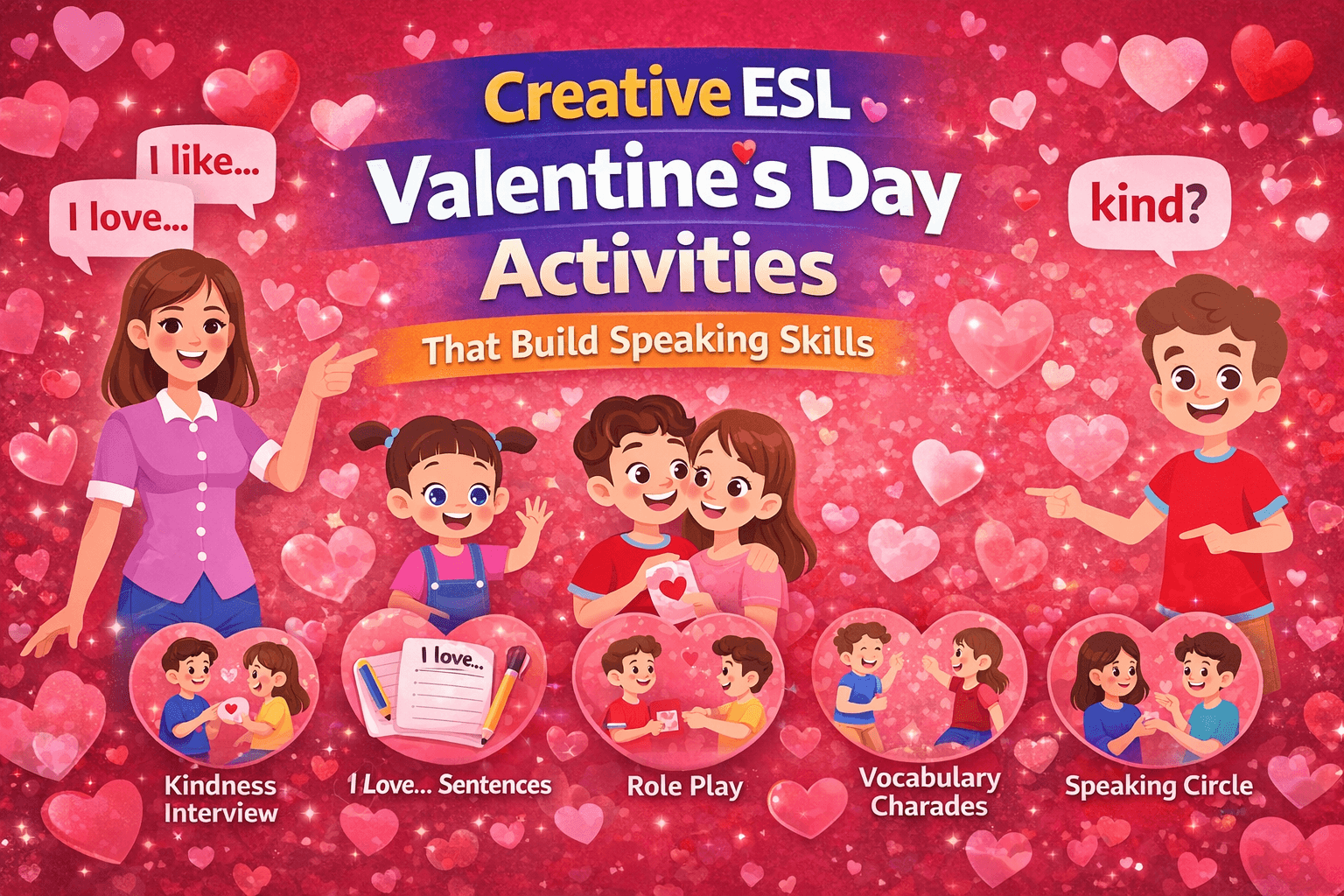
Valentine’s season is one of the most engaging times of year for young learners. The theme of love, friendship, kindness, and connection naturally encourages communication. However, many teachers fall into the trap of using Valentine’s Day as a vocabulary-only lesson filled with crafts and themed worksheets.
If your goal is to build real language development, you need ESL Valentine’s Day activities that go beyond naming words and actually strengthen speaking skills.
In this guide, we’ll explore creative, structured, and practical esl valentine’s day activities that help students speak more confidently while keeping your lesson purposeful and organized.
Why Valentine’s Day Is Perfect for Speaking Practice
Valentine’s topics are emotionally relatable. Students understand concepts like:
- Love
- Friendship
- Kindness
- Giving
- Sharing
Because they already know these ideas in their first language, they can focus more on expressing them in English.
This makes Valentine’s Day one of the best opportunities to increase:
- Sentence building
- Personal expression
- Question-and-answer practice
- Descriptive speaking
- Confidence in conversation
Instead of treating Valentine’s as a one-day craft lesson, you can turn it into a structured speaking unit.
Activity 1: “I Love…” Sentence Builder
One of the simplest yet most effective esl valentine’s day activities is a structured sentence-building exercise.
Step 1: Introduce Core Verbs
Start with high-frequency verbs like:
- love
- like
- give
- hug
- help

These verbs are not seasonal only, they are foundational English words.
Step 2: Build Simple Patterns
Use sentence frames:
- I love ______.
- I like ______.
- I give ______.
- I hug ______.
Students complete with:
- I love my mom.
- I like chocolate.
- I give a card.
I hug my friend.
Why This Builds Speaking Skills
- Students personalize answers.
- They repeat a consistent grammar structure.
- They gain confidence through predictable patterns.
Repetition + personalization = stronger fluency.
Activity 2: Kindness Interview
Valentine’s Day is also about kindness. Instead of just teaching the word “kind,” turn it into a speaking activity.
Teach Key Adjectives:
- kind
- friendly
- helpful
- sweet
Speaking Activity:
Students ask each other:
- Are you kind?
- Who is kind in your family?
- Is your teacher kind?
- Why is your friend kind?
Encourage full-sentence responses:
- My mom is kind because she helps me.
- My friend is kind because she shares.
- I am kind because I help my classmates.
This is one of the most powerful esl valentine’s day activities because it moves from vocabulary to reasoning.
Students are not just saying words they are explaining ideas.
Activity 3: Valentine’s Role Play
Role play dramatically increases speaking output.
Create simple scenarios:
- Giving a Valentine’s card
- Saying thank you
- Complimenting a friend
- Inviting someone to play
Example Dialogue:
Student A: “Happy Valentine’s Day!”
Student B: “Thank you!”
Student A: “You are a kind friend.”
Student B: “Thank you. You are kind too.”
You can extend by adding:
- Why?
- How?
- What do you like?
This turns a short exchange into meaningful interaction.
Activity 4: “Who Do You Love?” Speaking Circle
This activity works both online and in-person.
Students answer:
- Who do you love?
- Why do you love them?
- What do you do together?
Encourage complete responses:
- I love my dad because he plays with me.
- I love my sister because she helps me.
- I love my friend because she is kind.
This is one of the easiest esl valentine’s day activities to adapt for different levels.
For Beginners:
Keep it short:
- I love my mom.
For Higher Levels:
Add conjunctions:
- I love my mom because she cooks for me and helps me with homework.
Activity 5: Valentine’s Vocabulary Charades
If your students need movement and energy, turn vocabulary into a speaking game.
Write words like:
- hug
- give
- love
- help
- share
One student acts the word. The class guesses using full sentences:
- You are hugging.
- You are giving a gift.
- You love your friend.
This strengthens verb usage and pronunciation.
It’s playful but structured.
How to Structure the Entire Lesson (25–30 Minutes)
Here’s how you can organize your esl valentine’s day activities into one cohesive lesson.
1. Warm-Up (5 Minutes)
Quick questions:
- What is Valentine’s Day?
- Who do you love?
Introduce core verbs.
2. Vocabulary + Sentence Frames (10 Minutes)
Practice:
- I love ______.
- My friend is ______.
Students repeat and personalize.

3. Speaking Practice (10 Minutes)
Choose one:
- Kindness interview
- Role play
- Speaking circle
Encourage full-sentence answers.
4. Wrap-Up (5 Minutes)
Ask:
- Who is kind?
- What did you learn?
- Say one Valentine’s sentence.
Simple review reinforces retention.
Why Structured ESL Valentine’s Day Activities Work Better
Many teachers search for esl valentine’s day activities and find:
- Coloring pages
- Craft templates
- Printable cards
- Word searches
These are fun but they don’t necessarily build language.
When activities focus on structured speaking:
- Students talk more.
- Grammar improves naturally.
- Vocabulary sticks longer.
- Confidence increases.
A structured approach ensures Valentine’s Day becomes part of real language growth not just decoration.
Adapting for Online ESL Teachers
If you teach online, these esl valentine’s day activities work beautifully because they:
- Encourage camera interaction
- Require verbal participation
- Avoid heavy materials
- Focus on spoken output
You can:
- Use digital slides for sentence frames
- Ask students to type answers
- Call on students randomly
- Use thumbs up/down for quick checks
The key is repetition within structure.
Extending Beyond Valentine’s Day
The best seasonal lessons connect to long-term learning.
These Valentine’s words can reappear in:
- Family units
- Character education units
- Friendship lessons
- Daily routine lessons
- Emotion vocabulary
For example:
- I help my mom.
- My teacher is kind.
- I like my friends.
- We share toys.
When esl valentine’s day activities are built around core verbs and adjectives, they become reusable year-round.
Common Mistakes to Avoid
When planning your Valentine’s ESL lesson, avoid:
- Teaching too many themed words at once.
- Focusing only on crafts.
- Skipping sentence-building.
- Not giving students speaking time.
- Letting the lesson become teacher-centered.
Speaking improves when students talk more than the teacher.
Final Thoughts
Valentine’s Day offers a natural opportunity to build speaking skills in a meaningful way. By choosing structured, communication-focused esl valentine’s day activities, you can help students:
- Build complete sentences
- Express feelings
- Practice adjectives
- Develop conversational confidence
- Strengthen grammar patterns
The key is structure. When vocabulary connects to sentence frames and personalization, students move beyond repeating words they begin communicating.
Creative does not mean chaotic. With the right approach, your esl valentine’s day activities can be engaging, interactive, and academically strong at the same time.


Leave a Reply