
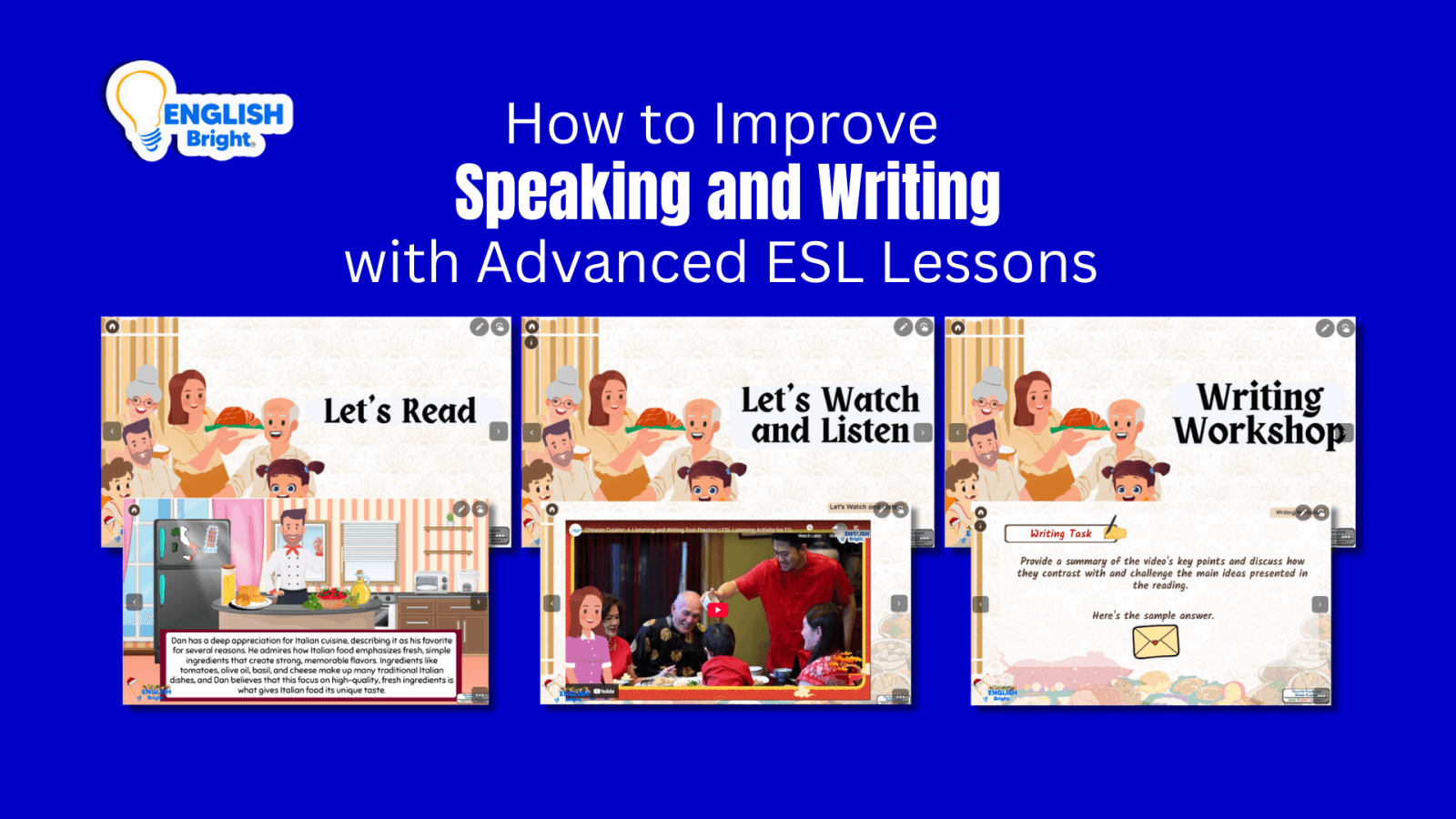
Advanced ESL lessons go beyond basic vocabulary and grammar—they give learners the tools to express complex ideas, communicate confidently, and write with clarity and structure. For high-level learners, improving speaking and writing requires consistent practice, meaningful input, and real-life communication tasks that challenge their language skills.
In this article, we explore how teachers can elevate advanced learners using focused activities in speaking, writing, reading, and listening. We also look at how English Bright–style learning components—such as Reading passages, Let’s Watch and Listen activities, Writing Workshop, and Time to Write—help build accuracy, fluency, and confidence.
Why Speaking and Writing Matter in ESL Lessons
Speaking and writing are productive skills, meaning students must actively construct language rather than recognize it. In advanced ESL lessons, learners should be able to:
- Express opinions clearly
- Explain complex ideas
- Present arguments or solutions
- Summarize information
- Write coherent, structured paragraphs and essays
- Speak with fluency, accuracy, and confidence
Effective ESL lessons at this level must push students beyond simple sentences and help them communicate with precision and style.
Try this lesson with you students: Level 6 Unit 1, Lesson 1: Favorite Foods and Global Cuisines

1. Improve Speaking Skills Through High-Level ESL Lessons
A. Discussion-Based Reading in ESL Lessons
Reading is one of the most effective tools for improving speaking. It introduces advanced vocabulary, academic sentence structures, and real-world topics.
In advanced ESL lessons, students can:
- Read a passage on a global issue
- Identify key arguments
- Discuss the author’s viewpoint
- Share personal opinions
This structured input gives students a strong foundation before speaking, allowing them to use higher-level vocabulary with confidence.
B. “Let’s Watch and Listen” Activities in ESL Lessons
Authentic audio and video expose students to:
- Real-life pronunciation
- Natural pacing
- Idioms and expressions
- Academic and professional speaking styles
After watching or listening, students can:
- Give a summary
- Answer discussion questions
- Compare viewpoints
- Role-play scenes
These activities help bridge listening comprehension and confident speaking in advanced ESL lessons.
2. Improve Writing Skills Through Structured ESL Lessons
A. Writing Workshop in ESL Lessons
Advanced learners benefit from guided writing instruction. A Writing Workshop approach includes:
- Planning ideas
- Outlining paragraphs
- Writing strong topic sentences
- Adding supporting details
- Revising and editing
This process helps students produce essays, reports, opinion pieces, and narratives with clarity and confidence.
B. Time to Write: Independent Practice in ESL Lessons
After structured support, students need independent writing time. “Time to Write” activities encourage fluency and creativity through tasks such as:
- Descriptive paragraphs
- Opinion essays
- Story endings
- Emails and short reports
This balance strengthens grammar accuracy, vocabulary use, and overall writing confidence in advanced ESL lessons.
3. Integrating Reading and Listening in ESL Lessons
Strong ESL lessons integrate receptive skills to support productive skills.
A. Reading-to-Speaking Connection
Students read a passage, analyze it, then discuss ideas orally. This builds vocabulary and confidence before speaking.
B. Listening-to-Writing Connection
Students watch a video or listen to audio, then respond with a written summary or reflection—improving comprehension and writing fluency.
4. Using Short Stories in Advanced ESL Lessons
Short stories are highly effective in advanced ESL lessons because they expose learners to expressive and nuanced language.
Students can:
- Summarize the plot
- Analyze character motivation
- Discuss themes
- Rewrite alternative endings
- Write reflective responses
These tasks combine creativity with advanced language use.
5. Fun and Engaging Games in ESL Lessons
Advanced ESL lessons don’t have to be overly serious. Games can reinforce high-level language skills while keeping learners engaged.
Try:
- Story Chain – Students add sentences to build a complex narrative
- Opinion Corners – Students defend viewpoints using advanced vocabulary
- Describe and Guess – Abstract concepts explained using precise language
- Presentation Roulette – Impromptu speaking on advanced topics
Conclusion
Improving speaking and writing in advanced ESL lessons requires a balanced approach that integrates reading, listening, structured writing, and meaningful interaction. By using strategies such as Reading passages, Let’s Watch and Listen, Writing Workshop, Time to Write, short stories, and engaging games, teachers can help learners reach higher levels of fluency.
With effective ESL lessons and well-designed resources like those from English Bright, advanced learners can communicate confidently, clearly, and professionally.

Leave a Reply